
Rakeback and VIP Programmes at Crypto Basketball Sportsbooks (UK)
 Available in US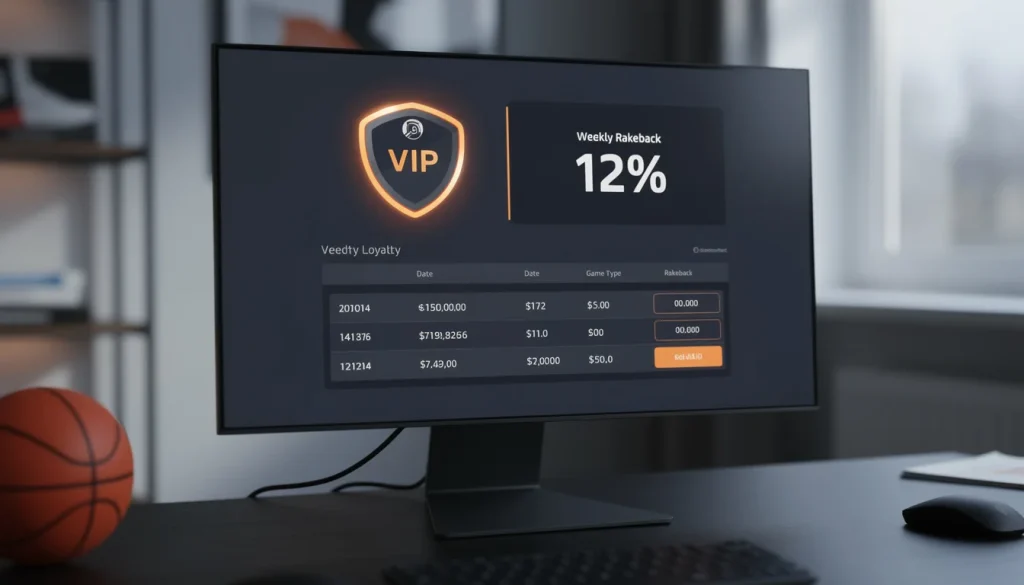
The line that pays more than my best winning week
In December 2024 I worked out that the rakeback paid to my account at a single crypto sportsbook over the previous twelve months exceeded my best winning week of the year. The total wasn’t huge – about £1,200 across the year – but it was guaranteed money returned regardless of whether my betting hit rate was up or down. The bookmaker was paying me to bet through volume, and the volume was money I’d have placed anyway.
Rakeback and VIP programmes are the ongoing loyalty mechanisms that crypto sportsbooks use to retain active users. Stake.com generated $4.7 billion in gross gaming revenue in 2024, and Easygo Entertainment reported £135 million in pre-tax profit in 2024-25 – both numbers built on customer-lifetime-value calculations that rakeback is a primary input into. For a basketball bettor placing meaningful volume through the year, the rakeback equation often matters more than the welcome bonus.
This guide covers what rakeback actually is, how VIP tiers actually work, the volume thresholds that move you up tiers, the difference between BTC and stablecoin rakeback, and where the math justifies VIP loyalty.
Rakeback in plain English
Rakeback is a percentage of the bookmaker’s margin returned to you as cash or bonus credit on a regular schedule. The “rake” the bookmaker takes is built into the margin on each market – a basketball spread at -110 has roughly 4.5% margin, of which the rake structure returns some percentage to active players.
Typical rakeback rates at crypto sportsbooks for active basketball bettors run from 5% to 20% of the margin paid through bets. A player betting £10,000 a month across basketball markets at 4% average margin is paying about £400 in margin per month; 10% rakeback returns £40 per month. The numbers compound across a year.
The structural reason rakeback is generous at crypto books: the operators are competing for active users in a market where switching costs are low and customer acquisition is expensive. A high-volume basketball bettor who plays regularly is worth several times the welcome bonus over their lifetime, and rakeback retains that value better than other mechanisms.
The mechanics vary across operators. Some pay rakeback daily as a small percentage of the previous day’s volume. Others pay weekly or monthly in larger lump sums. Some calculate from gross wagering volume; others from net margin paid (which they calculate based on a model of expected margin per market type). The differences matter for a serious bettor working out which book is actually paying the best ongoing economics.
How VIP tier mechanics actually work
VIP programmes layer additional benefits onto the base rakeback rate. The structure is broadly similar across crypto books: tiers from Bronze through Diamond (or some equivalent), with higher tiers unlocking better rakeback percentages, faster withdrawal limits, dedicated account management, and sometimes ad-hoc bonuses tied to monthly volume thresholds.
The tier progression is volume-driven, not time-driven. You move up tiers by placing wagering volume in a calendar month or rolling 30-day period; you move down tiers by failing to meet volume thresholds. Most programmes have a grace period before demotion – typically 2-3 months – but sustained inactivity eventually drops you down.
The volume thresholds vary widely. Entry-level tier might require £500-1,000 of monthly volume. Mid-tier might require £5,000-10,000. Top-tier (Diamond or VIP) might require £50,000 or more in a calendar month. The rakeback rate at top tier might be 2-3 times the entry-level rate.
The honest math on VIP progression: most basketball bettors are not high-volume enough to benefit from top-tier rates. A punter betting £30,000 a month sees rakeback go from say 10% to 18% – meaningful but not transformative. A punter betting £200,000 a month moving from 12% to 22% picks up an additional £8,000 a year, which is genuinely significant. The leverage depends on your underlying volume.
Basketball volume thresholds and where the tiers move
Basketball generates relatively high volume per active bettor because the schedule is daily through most of the season. A regular NBA bettor placing 2-3 bets per night at £50-100 per bet generates £30,000-150,000 of volume per regular-season month. That puts them comfortably in mid-tier VIP at most crypto books, with rakeback rates of 12-15%.
The seasonal pattern matters. NBA volume peaks December through April; March Madness adds another concentrated volume month; the playoff window in May-June is shorter but high-intensity. WNBA bridges the summer for the punter who continues betting; the EuroLeague autumn-spring season provides European basketball volume. A year-round basketball bettor can sustain high-tier VIP across twelve months in a way that football-only bettors can’t replicate.
The other useful feature of basketball-driven volume: the markets are predominantly straight bets at modest margin, which is exactly the activity the books most want to reward. Parlay-heavy bettors get less favourable VIP treatment because parlays already pay the book heavy margin. Basketball spread and total bettors get treated well because the volume is concentrated in the operator’s preferred market types.
What I track in my own VIP management: monthly volume against next-tier threshold, rakeback paid against expected margin, and the rate at which my withdrawal limits scale at higher tiers. The withdrawal limit is the one operational feature that gets meaningfully better at top tiers – a punter who turns over £100,000+ per month wants to be able to withdraw £25,000+ on demand without queueing, and that capacity scales with tier status.
BTC versus stablecoin rakeback
The currency rakeback is paid in matters for the same reasons currency exposure matters elsewhere in the crypto sportsbook ecosystem. BTC rakeback compounds with BTC price movement – a 10% rakeback of £400 paid in BTC at $60,000 per coin can be worth £440 if BTC rises to $66,000 over a holding month. The same rakeback paid in USDT preserves GBP value but doesn’t participate in upside.
Most crypto sportsbooks pay rakeback in the currency you bet in. If your active balance is BTC, rakeback comes as BTC. If you’ve converted to stablecoin, rakeback comes as stablecoin. Some operators offer choice; most don’t.
The strategic consideration: if you’re carrying a BTC-denominated bankroll and you believe BTC is appreciating over the medium term, BTC rakeback adds another small position to that bet. If you’re managing a stablecoin-denominated bankroll for currency stability, stablecoin rakeback fits that strategy.
The boring reality: rakeback amounts are typically small enough that the currency choice doesn’t drive significant year-end value differences. A 10% currency move on £1,200 of annual rakeback is £120, which matters less than a 1% improvement in rakeback rate. Optimising the rate matters more than optimising the currency.
Comparing actual programmes at the operators that take basketball seriously
Without naming specific operators, the structural differences worth noting across the major crypto sportsbooks that handle basketball volume:
One major operator runs a tiered programme where rakeback scales from 5% at entry-level to 18% at Diamond, with tiers requiring monthly volume thresholds at £1,000, £10,000, £50,000, and £200,000. Withdrawal limits scale from £10,000 daily at entry to £100,000+ daily at top tier. The programme is straightforward, transparent, and the volume thresholds are achievable for an active basketball bettor.
Another major operator runs a points-based system where every bet earns points at a rate that depends on the market type. Points can be redeemed for cash credit at a variable conversion rate, and tier status affects both the points-earning rate and the redemption rate. The system is less transparent than tiered rakeback but can be more generous for the bettor who optimises which markets they bet.
A third structure offers a flat rakeback rate that doesn’t tier – say 12% across all volume – combined with monthly volume bonuses paid as additional credit when you exceed thresholds. This works well for high-volume bettors with predictable monthly patterns but provides less incentive to push for top-tier status.
The honest assessment: comparing programmes properly requires modelling your own betting volume and pattern through each programme’s mechanics. The headline rates don’t tell you which programme actually pays more – that depends on your specific bet types, your stake sizing, and your monthly volume profile.
For most active basketball bettors, the rakeback economics dwarf the welcome bonus economics over a year. A £200 welcome bonus is a one-time event; £100-200 monthly rakeback compounds across the season. For the punter trying to optimise crypto sportsbook value, the rakeback programme should weigh more heavily in the operator selection than the headline welcome offer. The mechanics of welcome bonuses themselves – how they interact with wagering requirements and contribution rates – get covered in detail in our breakdown of crypto sportsbook welcome bonuses for basketball bettors.
What I actually do with rakeback and VIP
My routine: track monthly volume across each book where I have an active account, monitor rakeback paid against expected margin to verify the rates are being applied correctly, and consolidate volume at the operator with the best ongoing economics for my specific bet types.
The consolidation point matters. Splitting volume across four books at entry-tier rakeback rates pays less than concentrating volume at two books at mid-tier rakeback rates. The structural reward of loyalty is real at crypto sportsbooks, and the punter who treats each account independently leaves money on the table.
The other discipline: not chasing tier progression by betting larger than my normal sizing. The temptation to push volume into a higher tier is a version of the same trap that bonus-chasing presents. If my normal pace puts me in mid-tier rakeback at 13%, that’s the structural return on my activity. Pushing to top-tier 18% by betting outside my normal pattern costs me more in margin than it gains in rakeback.
Rakeback is the slowest, most reliable form of value at a crypto sportsbook. It doesn’t change game-to-game results. It doesn’t compensate for bad bets. It just returns a small percentage of the margin I’d pay anyway across the year. Over twelve months of active basketball betting, that small percentage adds up to a meaningful figure – the £1,200 I tracked across 2024 was a calm, boring number that quietly beat several individual betting weeks for total contribution to my year-end results.
How does rakeback differ from cashback at a crypto basketball sportsbook?
Rakeback returns a percentage of the margin you pay across all bets, regardless of whether individual bets win or lose. Cashback returns a percentage of your net losses across a defined period. Rakeback pays more on volume; cashback pays more on losing runs. Active basketball bettors typically prefer rakeback because the volume is consistent through the season.
Which VIP tier actually pays off for an NBA-focused bettor?
Mid-tier (typically the second or third tier in a five-tier programme) is where the rate-to-effort ratio is best for most active NBA bettors. Monthly volume requirements of £10,000-30,000 are achievable with normal daily betting, and the rakeback rates at that tier (12-15%) materially exceed entry-tier rates. Top-tier rewards require volume that most recreational punters can"t sustain.
Articles
Published by the Bitcoin Basketball Bets team.
