
NBA Point Spread Betting with Bitcoin for UK Punters
 Available in US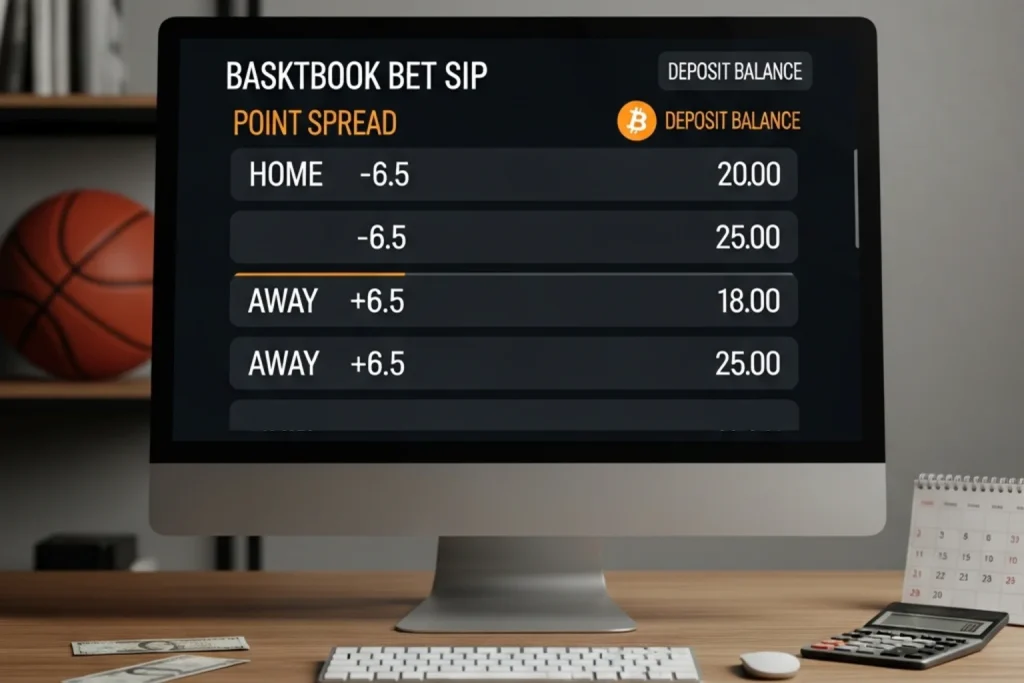
Analyzing Crypto NBA Point Spread Volumes
If the moneyline is the front door, the point spread is where most of the furniture is. The first NBA bet I ever lost a meaningful amount on was a spread – a Lakers -7.5 line that I covered by exactly six points. That kind of result teaches you faster than any guide. The spread takes a binary “who wins” question and turns it into a margin question, which is harder, more interesting, and where the value sits when the line is mispriced.
At crypto sportsbooks, the spread carries the bulk of NBA volume. Basketball stakes have nearly doubled at major books in 2026, and the spread market – not the moneyline – is the engine of that growth because it’s where house margin sits between 4-5% on a tight book. For UK punters used to football handicaps, the NBA spread feels structurally familiar but settles differently because basketball doesn’t have football’s scoring rhythm.
This guide covers what the spread really means, why NBA doesn’t have an equivalent of the NFL’s “key numbers”, how a Bitcoin-funded spread bet sizes and settles, and where you should place the spread inside a broader betting routine that doesn’t burn the bankroll in two weekends.
The spread, decoded in one sitting
A point spread is the bookmaker’s attempt to make a one-sided matchup into a coin flip. Lakers are favoured to beat the Wizards on the road – the spread says Lakers -6.5, Wizards +6.5. To “cover” the spread, the Lakers need to win by seven or more. The Wizards “cover” if they win outright or lose by six or less. Half-points exist precisely so there’s no possibility of an exact-margin tie.
The price on each side is usually -110 in American odds, which means you risk 110 to win 100. Sometimes books will shift the price to -105 or -115 instead of moving the line itself, which is how they balance the action they’re taking. Punters who only watch the spread number and ignore the price next to it are missing half the information. Two books offering the same -6.5 line with different prices are not the same bet.
The vital concept is that the spread doesn’t predict the actual margin; it predicts where the betting market splits 50/50. The book wants equal money on both sides so they pocket the vig regardless of result. When the line moves before tip-off, it’s almost always because action has come in heavily on one side. The line that opens at Lakers -6.5 and closes at Lakers -7.5 didn’t change because the Lakers got better – it changed because the public came in heavy on Boston, and the book moved the number to attract money on the other side.
When a spread settles exactly on the integer line – Lakers favoured at -6, win by six – that’s called a “push”, and the stake is returned. The half-point on -6.5 exists to remove that ambiguity. The most generous crypto books offer “alt lines” at -5.5 or -7.5 with adjusted prices, letting you trade off line value against price value. The trade is real and it isn’t always in your favour.
Why NBA spreads don’t have NFL-style key numbers
In American football, key numbers are everything. Roughly 15% of NFL games land on a margin of three points, another 9% on seven. A bookmaker moving an NFL line from -3 to -3.5 changes the probability of cover meaningfully. NBA doesn’t work this way, and understanding why is what separates someone who can copy-paste a strategy from someone who actually thinks about basketball.
NBA scoring is essentially continuous from a margin-distribution perspective. An average NBA game features about 220 points combined. Margins of victory cluster softly around small single digits but spread evenly across the full distribution. There’s no sharp peak at three or seven because basketball scoring isn’t built around discrete touchdown-and-extra-point chunks. A team trailing by six in the final minute can intentionally foul, miss-and-rebound, and turn it into a four-point game in twenty seconds. The endgame distorts margins in ways NFL endgames don’t.
The practical consequence: half-point moves around -6 or -8 don’t carry the cover-probability swing they would in football. A Lakers -7 to -7.5 move costs you maybe 1-2% on cover probability, not the 4-5% an NFL -3 to -3.5 move would imply. The same is true of buying the hook on +6.5 to +7. The cost the book charges for the half-point – usually 20 cents on the price – is occasionally fair, often slightly expensive, and almost never the slam-dunk steal that NFL bettors have learned to look for.
This matters when you’re picking a side. Don’t pay big premiums to move an NBA line a single half-point unless you have an independent reason – a specific player’s known performance against the line. The spread market in NBA rewards reading injuries, rest schedules and pace differences, not micro-managing the integer.
Spread or moneyline: which one earns its place tonight
The moneyline asks “who wins”. The spread asks “by how much, relative to expectation”. They look like the same question wearing different clothes. They’re not. They reward different reads and they belong in different parts of your weekly portfolio.
Take a Lakers vs Memphis game with Lakers favoured at -6.5 and the moneyline at -260. If you think the Lakers win comfortably, the moneyline price means you’re paying 260 to make 100 – implied probability 72%. The spread at -6.5 prices around -110, implied 52%. To make the moneyline the better play, you need to be more than 72% confident in a Lakers win. To make the spread the better play, you need to think they’ll win by at least seven more than half the time.
Those are very different reads. The moneyline rewards confidence in a result. The spread rewards confidence in the magnitude of the result. Sharp NBA bettors lean towards the spread because the line itself is more fairly priced – books spend more time perfecting spreads than moneylines because that’s where the volume goes. Crypto sportsbooks in particular tend to be slower to update moneyline prices on heavy favourites, which is where soft moneyline value sometimes appears on -300 or worse lines. For everything else, the spread is the more disciplined market.
If your read is about pace and total scoring rather than which side covers, the natural shift is to a different market entirely – the over/under. The decision tree for picking between sides and totals on a single NBA night is laid out in detail in the NBA totals walkthrough.
What a Bitcoin-funded spread bet looks like end to end
Setup: Lakers -6.5 at -110, home against Phoenix on a Friday night, tip-off 03:00 UK time. Your unit is £400, which at today’s BTC price of £40,000 means you stake 0.01 BTC. You place the bet, the ticket locks: 0.01 BTC at -6.5, returning 0.01909 BTC if Lakers cover.
Outcome: Lakers win by eleven. Spread covered. Your balance moves from 0.01 BTC pre-settlement to 0.01909 BTC after the final whistle – profit of 0.00909 BTC. The book settles automatically; you don’t claim, you don’t confirm. If the price posted in the bet slip was -110, your return is your stake divided by 1.10 plus your stake back, which is the standard American -110 math.
The currency risk in the gap between placing and settling is small for spreads because settlement happens almost instantly after the final whistle. The currency risk on the surviving balance is real. If BTC is at £40,000 when the bet settles and £39,000 a week later when you withdraw, the 0.00909 BTC profit you booked at £363.60 is worth £354.51 at the moment of withdrawal – a 2.5% drag on the win.
That’s not a quirk; that’s the structural reality of holding a betting bankroll in a volatile asset. Some punters convert winnings to a stablecoin balance immediately after settlement. Some leave them in BTC and accept the drift in both directions. Neither is wrong – what’s wrong is not deciding which you’re doing and drifting between approaches mid-season.
Sizing spreads when the asset under you keeps moving
The case for a fixed GBP-denominated unit gets stronger the longer you stay in the market. NBA seasons are 82 regular-season games per team plus playoffs – that’s six months of nightly volume. BTC over those six months can swing 20-40% either direction without breaking trend. If you size in coin and forget the GBP, you’re effectively letting Bitcoin’s chart decide your real-money stake size, which is not a strategy anyone would design from scratch.
The clean approach is to fix the GBP unit – say £200 per spread bet – and recalculate the coin amount weekly. Some punters do it daily during high-volatility weeks. The reason it’s weekly and not per-bet is that constant re-sizing creates its own friction and decision fatigue. Once a week you check the BTC price, divide your weekly unit by it, and that’s your stake for the next seven days regardless of intraday swings.
The second rule of NBA spread sizing is to assume a 50% hit rate at -110 even on your best plays. At -110, breakeven is 52.4%. The difference between a profitable spread bettor (53-55%) and a losing one (49-51%) is one or two cover decisions per twenty bets. Sizing has to survive a streak of nine losses in twenty wagers, which happens regularly on any rational hit rate. If your bankroll can’t take that drawdown without forcing you to cut stakes, it’s already too aggressive. Most experienced spread bettors hold a working bankroll equal to at least 50 units, and many double that.
Why are NBA spreads usually between 4 and 14 points?
The 4-14 range covers most realistic talent gaps in the NBA without distorting market depth. Below four, the line is essentially a moneyline with a small adjustment. Above 14, the favourite tends to rest starters early once they lead by 25, which collapses the cover probability and pulls the line back. A few games per season open at 16 or higher when there are multiple injuries on one side, but those lines move fast and trade thin.
Does a push return my Bitcoin stake at all sportsbooks?
On a half-point spread like -6.5, a push is impossible – the result either covers or doesn"t. On integer lines like -6 or -7, a push returns the stake at virtually every crypto sportsbook, which is the standard industry rule. Read the bet slip terms before placing because a small minority of books treat pushes as half-losses; that"s unusual and worth avoiding.
Articles
Published by the Bitcoin Basketball Bets team.
