
Provably Fair Basketball Betting at Crypto Sportsbooks
 Available in US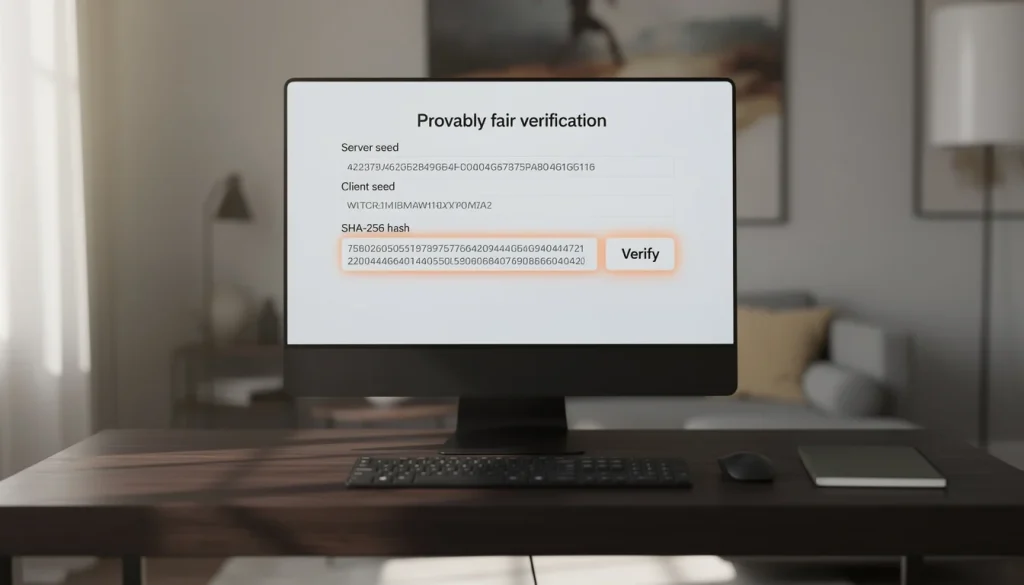
Applying Provably Fair Tech to Sports Betting Spreads
The first time I saw “provably fair” badged on an NBA betting page, I genuinely had to stop and think about what it could possibly mean. Provably fair is a phrase that grew up around crypto casino games – dice, blackjack, roulette – where the outcome is generated by software inside the operator’s stack. The whole point was to let players verify that a coin flip really was 50/50 and the operator wasn’t cooking the random number generator. Slapping that label on a market that settles on whether the Lakers cover a 6.5-point spread? That’s a category error pretending to be a feature.
This matters because the global crypto-gambling market hit $81.4 billion in gross gaming revenue in 2024 – five times its 2022 value – and operators are racing to differentiate. “Provably fair” is one of the differentiation badges, and it gets applied liberally to product surfaces where the underlying concept doesn’t fully apply. With a single operator like Stake.com clearing $4.7 billion in annual gross gaming revenue, the marketing arms race is real and the labels matter more than the underlying mechanics suggest they should.
This guide unpacks what provably fair actually is in its native casino context, why it doesn’t translate cleanly to sports betting outcomes, how it does apply meaningfully to crypto sportsbook settlement, and where the limits of the term sit when it gets applied to an NBA market.
What provably fair was built to solve
Provably fair is a cryptographic protocol designed for games where the operator generates the random outcome. The classic case is a dice game: the operator’s server picks a number, the player picks a number, and a hash function combines them to determine the result. Provably fair lets the player verify, after the fact, that the operator’s number was generated before the player’s bet and wasn’t altered after the fact to produce a losing outcome.
The mechanics are straightforward in essence. Before the bet, the operator generates a server seed and shows the player a hash of that seed – a cryptographic fingerprint that commits the operator to that specific seed without revealing it. The player contributes a client seed (usually a random string the player provides). After the bet settles, the operator reveals the server seed. The player can compute the hash of the revealed seed and confirm it matches the pre-bet hash, proving the server seed wasn’t changed during the bet. The combined hash determines the result.
This solves a real problem in casino games where the operator controls the random number generation. Without provably fair, you’re trusting the operator to roll an honest dice; with it, you can verify after the fact. For dice, slots, crash games and any product where the operator generates outcomes, provably fair is a meaningful integrity layer.
For sports betting, the random number generator is the basketball game itself. The Lakers cover or they don’t, based on what happens on a court in Los Angeles, observed by referees, recorded by official scorers, and consumed by every sportsbook on earth simultaneously. The operator isn’t generating the outcome. There’s no seed to commit to. The provably fair primitive doesn’t naturally apply.
Why sports outcomes can’t be made “provably fair”
The outcome of an NBA game is a real-world event. The score is determined by twenty hours of game time across a season, by referees on the floor, by official scoring rules, by the league’s stat keepers. The crypto sportsbook isn’t generating the result – it’s reading the result from the league’s data feed and applying it to your bet. There’s nothing to make provably fair about the underlying event.
What can be made transparent and verifiable is the settlement layer. The book’s stated line was Lakers -6.5. The final score was Lakers 112, Boston 105. The cover condition was Lakers margin of victory ≥ 7. Lakers won by 7. Cover settled. Each step in that chain is checkable against external data sources, and a transparent book makes each step explicit on the bet history page. That’s not “provably fair” in the cryptographic sense – it’s “transparent settlement” – but it’s where the underlying concept of verifiability does apply to sports markets.
Some books market this as provably fair settlement, which is more honest than calling the entire product provably fair. The book is committing publicly to the score they used, the line they offered, and the settlement rule they applied. If they ever deviate from that – settling on a different score, changing the line retroactively, applying a different cover rule – the deviation is visible to anyone who can read the bet history and check it against the league record.
The dishonest version is when a book uses “provably fair” as a generic trust signal across all products without explaining what it actually means for sports markets. Tim Miller, executive director of research and policy at the UK Gambling Commission, has said that “innovation should be and can be one of our central consumer protection tools when it comes to the illegal market” – and that framing applies here. Genuine transparency on settlement is the kind of innovation that protects punters. Marketing veneer that borrows a casino term without delivering its meaning is the kind that masquerades as innovation while delivering nothing.
How verification actually works when it does
On a casino game with a real provably fair implementation, verification is a sequence of steps a player can run independently. Get the server seed hash before the bet. Place the bet. After settlement, get the revealed server seed. Hash the revealed seed yourself using SHA-256 or whatever hash the operator stated. Confirm it matches the pre-bet hash. Then combine the seeds per the operator’s stated formula and confirm the result matches what the operator paid out.
This sequence takes about two minutes the first time you do it, less after. The operator can’t fake the result without breaking the hash commitment, which is mathematically infeasible. For dice and similar games, provably fair is a real consumer-protection feature when implemented correctly.
On a sports market, the equivalent verification would be: the book published the line in advance, the line is recorded on the bet history page, the score is determined by the league’s official data, the settlement applied the published cover rule to the official score. Anyone can check the score against the league’s website. Anyone can check the bet history against their own records. The verification chain is informal but checkable. No cryptography is required; the events are public.
The thing that breaks this informal verification is when the book retroactively changes either the line or the settlement rule. Some books have terms permitting them to void bets if “obvious error” applied to the line. The error provisions are sometimes legitimate (a line posted at 6.5 that should obviously have been 16.5 because of a missing digit) and sometimes used as ex-post-facto cover for the book. Reading the obvious-error terms before depositing is the realistic equivalent of provably-fair verification for sports – you’re checking the policy that determines whether the result you saw is the result you’ll get paid on.
The limits of the term in sports betting
Where provably fair can legitimately apply in a sports betting context is settlement on novelty markets that the book itself generates. If the book offers an NBA prop like “first jump ball winner” and that’s a market the book is essentially computing from a partial data source, the underlying mechanism is the book’s calculation, not a public event. Making that calculation cryptographically verifiable is a real provably fair application.
Where the term doesn’t apply is on standard markets settling on official league outcomes. A book that calls a moneyline market provably fair is using the term as marketing veneer, not as a technical claim. The check before treating any such badge as meaningful is to ask: what specifically is being made verifiable, and how can I verify it myself?
If the answer is “you can check our settlement matches the official score”, that’s transparency, not provably fair. Worth having; not what the casino-side term means. If the answer is a procedure involving hash commitments and seeds, then real provably fair mechanics may apply to the specific product. Most NBA markets at most crypto sportsbooks fall into the first category. The label is mostly noise.
For UK punters used to the FCA’s authorisation regime arriving in October 2027 and the structural transparency requirements UKGC imposes on licensed books, the provably fair label can be a confusing signal because it implies an integrity guarantee that isn’t quite what it sounds like. Bookmaker integrity in the licensed UK sector is enforced by audit and regulation, not by cryptographic proof. The crypto sector has both alternatives and gaps. Knowing which is which is part of the due diligence the next KYC and anonymity guide goes deeper on.
Who actually offers verifiable settlement in 2026
The honest answer is a small minority of crypto sportsbooks. Most operators marketing themselves as provably fair are applying the badge primarily to their casino products and letting the language drift across to their sportsbook surface without restructuring the underlying mechanics. The few books that have built genuine settlement transparency on sports markets typically publish the data feed they’re settling against, the timing of the settlement, and the rule applied – visible in the bet history page rather than buried in terms.
The check before treating any book’s transparency claim as substantive is to look at how a single past bet was settled in your account. Click into a settled NBA bet. Does the book show you: the exact line you took, the exact price, the final score they applied, the settlement time, the official source they used? If yes, that’s real settlement transparency, regardless of whether they call it provably fair. If no, the badge is marketing.
Some operators have additionally explored on-chain settlement – recording bet outcomes to a public blockchain so the record is immutable. This is more common on decentralised betting protocols than on centralised crypto sportsbooks. On-chain settlement gives you a verifiable, tamper-resistant record of what happened. It’s a slower and more expensive infrastructure layer, which is why most centralised operators haven’t adopted it for routine settlement.
The practical takeaway: don’t pay extra attention to a book because it badges itself provably fair. Pay attention to whether the book’s actual settlement practice is transparent and verifiable against external data. The badge is a heuristic; the underlying practice is what matters.
Can a sportsbook claim "provably fair" without on-chain settlement?
Yes, and most do. The provably fair label applies most rigorously to casino games where the operator generates outcomes. On sports markets, where outcomes come from real-world games, the closest equivalent is settlement transparency – the book publishing the line, score and settlement rule visibly enough for punters to verify against official records. That"s not on-chain, but it"s the meaningful version of the concept for sports.
Does provable fairness protect me if the book runs an offline KYC review?
No. Provably fair mechanics are about the integrity of bet settlement, not about account access, withdrawal processing or KYC. A book can run a clean settlement on every bet and still impose KYC checks that delay withdrawals or void accounts for terms breaches. The two systems are completely separate; provable fairness only addresses the bet-result integrity layer.
Articles
Prepared by the Bitcoin Basketball Bets editorial staff.
