
Basketball Asian Handicap Betting with Bitcoin: A UK Strategy Guide
 Available in US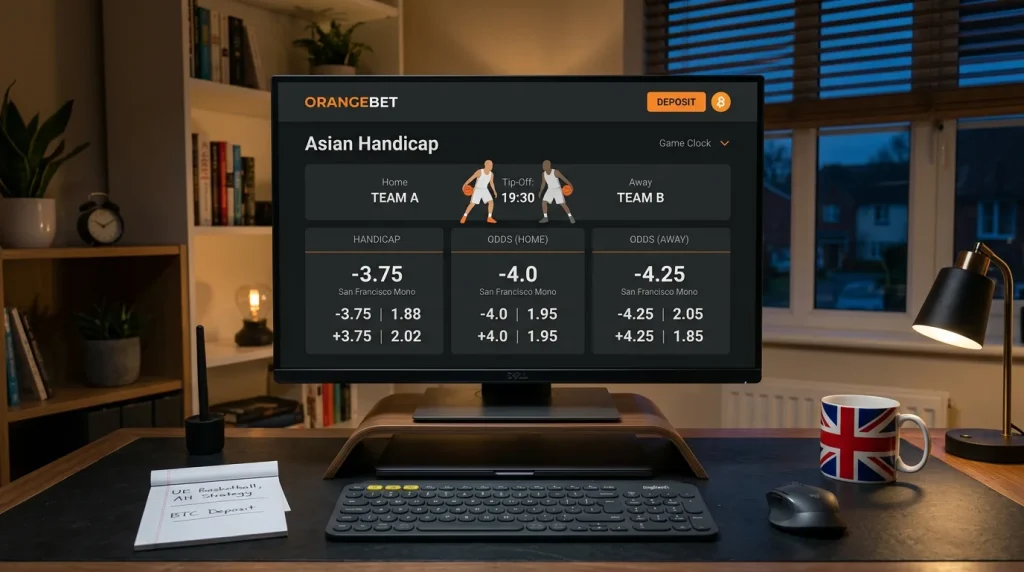
The handicap that saved my Lakers ticket in overtime
Two seasons ago I placed a Lakers -6.5 spread bet against the Suns and watched the game finish exactly 112-106 – a six-point margin, half a point short of my line. A few hundred quid evaporated on a single basket. A friend at the bar had the equivalent position as a -6.5 Asian Handicap split across -6 and -7, and walked away with half his stake back as a push on the -7 leg. That night I started taking AH seriously as an alternative to the standard point spread, and at crypto sportsbooks it’s now my default basketball market when the spread sits on a half-point I don’t trust.
Asian Handicap isn’t widely understood in UK basketball betting because the football market dominates the conversation and the US-style fixed-spread is the default at most American books. But on the crypto sportsbook circuit – Cloudbet, Stake, BC.Game, Sportsbet.io – AH is available across NBA, EuroLeague and most secondary basketball leagues, and the structural advantages over a fixed spread are real. This guide covers what Asian Handicap is, how it applies to basketball specifically, the quarter-line mechanics, the BTC payout math, and when AH beats the conventional spread.
Asian Handicap basics: half-stake splits and quarter lines
The Asian Handicap market originated in football betting in East Asia and migrated to basketball through the same operators who built deep football books. The core idea is to eliminate the draw outcome by giving one team a head start (or deficit) measured in goals, points, or fractions of those units. In basketball, the draw outcome doesn’t exist at full-time (overtime resolves all NBA and EuroLeague games), but the AH structure still applies because it does something the fixed spread doesn’t: it lets you bet on a half-stake split between two adjacent lines.
The notation is the bit that confuses newcomers. A -6.5 AH is identical to a -6.5 fixed spread – you need your team to win by 7 or more. A -6 AH is a “push” line: if your team wins by exactly 6, the stake is refunded; if they win by 7 or more, you win; by 5 or fewer (or lose outright), you lose. A -6.25 AH is the half-stake split: half your stake is on -6 (push potential) and half is on -6.5 (no push). And a -6.75 AH splits between -6.5 and -7, which is the equivalent for the higher-half side.
The advantage of the quarter-line is that it gives you a middle option between two half-point lines. On a fixed-spread book, you can have -6 or -6.5 but nothing in between. On an AH book, you can have -6.25 (mostly -6.5 risk with a partial refund chance if it lands on 6) or -6.75 (mostly -7 risk with a partial win if it lands on 7). The line shopping flexibility this gives you across a season is significant.
Basketball-specific application: where AH lines diverge from spreads
Basketball games swing through scoring runs in ways football matches don’t, and the final margin distribution is wider than it appears at first glance. NBA games regularly finish with a single-possession differential decided in the last minute, and the difference between a 5-point and 7-point final margin is often a single defensive stop or a garbage-time three. The spread market prices for the median outcome; the AH market prices for the same outcome but with the optionality to split risk across adjacent lines.
Cloudbet’s Q1 2026 market report showed basketball wagering doubled year-on-year on the platform, and AH was disproportionately represented in that growth. The mechanism is straightforward: bettors who’d been priced out of fixed-spread lines that didn’t match their conviction level found the quarter-line splits gave them precise risk-shaping options. A bettor who thinks the Lakers cover -6 comfortably but worries about a -7 push has a clean way to express that view at -6.25.
The basketball-specific quirk that matters: NBA totals interact with AH lines differently than they do with fixed spreads. A high-total game (240+) has a wider margin distribution than a low-total game (215-), which means the value of the quarter-line split widens in high-scoring environments. EuroLeague games typically run with totals 20-30 points lower than equivalent NBA fixtures, which compresses the margin distribution and reduces the AH advantage relative to a fixed spread. For NBA betting, AH is generally more valuable than for EuroLeague.
Live in-play betting captures the largest revenue share within UK online sports betting, and AH lines are the market structure best suited to live basketball action. The line moves multiple times during a game as the scoreline evolves, and the quarter-line precision lets you take live positions at lines that better reflect the in-game state than a fixed spread would.
Quarter versus half handicap: the settlement math
The settlement mechanics on quarter lines are where the AH advantage shows up most clearly. A -6.25 line resolves as follows: if the favoured team wins by 7 or more, both halves win and the bettor receives the full payout. If they win by exactly 6, the -6 half pushes (stake refunded) and the -6.5 half loses, so the bettor receives half their stake back as a partial loss. If they win by 5 or fewer, both halves lose and the bettor loses the full stake.
The -6.75 line works similarly on the other side. Win by 7 or more: full win. Win by exactly 7: the -6.5 half wins (full payout on that half) and the -7 half pushes (refund), so the bettor receives 1.5x stake on a 2x stake position – a partial win. Win by 6 or fewer: both halves lose.
The underdog quarter lines mirror this structure. A +6.25 underdog wins fully if their team wins outright or loses by 5 or fewer, pushes half on a 6-point loss, and loses fully on a 7+ point loss. A +6.75 underdog wins fully on a 6-point or fewer loss (or any win), wins half on a 7-point loss, and loses fully on an 8+ point loss.
The advantage of the quarter line over a half-line bet is precision. A bettor with a moderate conviction can express it with less binary risk than a fixed spread allows. The cost: AH books typically price quarter lines slightly less attractively than the equivalent fixed spread, because they’re factoring in the optionality value. In practice, the price difference is small (usually 1-2 cents on the dollar at tight books like Cloudbet) and is worth paying for the risk-shaping flexibility.
Bitcoin payout math: AH settlement in BTC terms
The settlement math for BTC-denominated AH bets follows the same logic as fiat AH but introduces FX considerations on the payout side. A bettor staking 0.01 BTC on a -6.25 line at 1.95 odds receives 0.0195 BTC on a full win, 0.005 BTC on a half-loss (refund of half the stake), and zero on a full loss. The BTC amount is fixed at placement; the GBP equivalent of the payout depends on the BTC/GBP exchange rate when the bettor withdraws.
The exposure to BTC price movement during the game is short – most NBA games settle within 2.5 hours of placement, and BTC volatility over that horizon is typically modest. The bigger FX consideration is the timing of withdrawal: a bettor who wins on a Wednesday night and withdraws Thursday morning is taking a BTC/GBP price risk overnight. Stablecoin-denominated AH bets (USDT or USDC) avoid this volatility entirely at the cost of foregoing potential BTC appreciation between placement and withdrawal.
The crypto-specific advantage on AH settlement is the speed of partial refunds. On a half-push outcome, the refund hits the sportsbook balance within minutes of game settlement, available for re-staking on the next game or for withdrawal. Fiat books that offer AH (and there aren’t many serving the UK market) typically process refunds on the same T+1 schedule as standard settlements, which means the capital sits idle for a day before re-deployment.
When Asian Handicap beats the standard spread
AH isn’t always the better choice for a basketball bettor. For high-conviction positions on whole-number or half-point lines that match the bettor’s view exactly, a fixed spread is simpler and often slightly better-priced. The AH advantage emerges in three specific scenarios.
First: lines that sit on a half-point the bettor doesn’t trust. The classic example is a -6.5 favourite where the bettor’s model suggests true value is -6.2. The quarter-line gives them a better expression than either fixed-spread alternative. Second: live betting where the line is moving fast and the quarter-line precision matters more. AH lines are the market structure built for live action, and the in-play AH menu at the major crypto books is deeper than the in-play fixed-spread menu. Third: small-edge value betting where the half-stake split materially affects the variance profile.
The bettor who has never used AH should start with a low-stakes quarter-line position on a single NBA game and watch the settlement flow. The mechanics become intuitive after two or three settled bets. After that, the choice between AH and fixed spread becomes a per-bet calculation rather than a default. The full mechanics of fixed-spread basketball betting at crypto sportsbooks sit in the point spread basketball crypto guide, and reading both gives you the toolkit to choose between the two structures for any given fixture.
The AH habit that compounds across a UK basketball season
UK punters who add Asian Handicap to their basketball toolkit gain a structural advantage over those who stay on fixed spreads only. The quarter-line precision, the partial-refund optionality, and the in-play depth all compound across an NBA regular season’s 1,230 games and a EuroLeague season’s 270 fixtures. The mechanics take a few bets to internalise, but the flexibility is worth the learning curve.
The crypto sportsbook environment is the natural home for AH basketball betting because the operators with the deepest AH menus are crypto-first (Cloudbet, Stake, BC.Game) and the settlement speed advantages compound on partial-refund outcomes. A UK punter operating across the 2026-2027 NBA and EuroLeague seasons with AH as a routine market choice will encounter risk-shaping opportunities that fixed-spread-only bettors won’t see. The cost of acquiring the habit is small; the cumulative benefit is meaningful.
How does a 0.25 quarter handicap actually settle on an NBA bet?
A -6.25 Asian Handicap splits your stake across two adjacent half-lines: half on -6 and half on -6.5. If your team wins by 7 or more, both halves win and you receive the full payout. If they win by exactly 6, the -6 half pushes (that portion of your stake is refunded) and the -6.5 half loses, so you receive a partial refund of approximately half your stake. If they win by 5 or fewer or lose outright, both halves lose. The +6.25 underdog side mirrors this: full win if your team wins or loses by 5 or fewer, half-push if they lose by exactly 6, full loss on a 7+ point loss. The quarter-line gives you a middle option between two fixed-spread alternatives.
Why is Asian Handicap less common in US-style basketball books?
The US sports betting market evolved around the fixed-point spread as the standard basketball handicap, with half-point lines eliminating push outcomes entirely. US operators built their pricing engines, trading desks, and bettor education around that fixed-spread structure. Asian Handicap originated in East Asian football betting and migrated to basketball through European and Asian operators, particularly the crypto-first sportsbooks that emerged in the 2010s. The result is a structural availability gap: US-licensed books rarely offer AH on basketball, while Curaçao-licensed crypto books (Cloudbet, Stake, BC.Game) routinely do. UK punters using crypto sportsbooks have access to the AH menu that US punters typically don"t.
Articles
Published by the Bitcoin Basketball Bets team.
