
NBA Finals Futures with Bitcoin: Long-Term Crypto Bets for UK Punters
 Available in US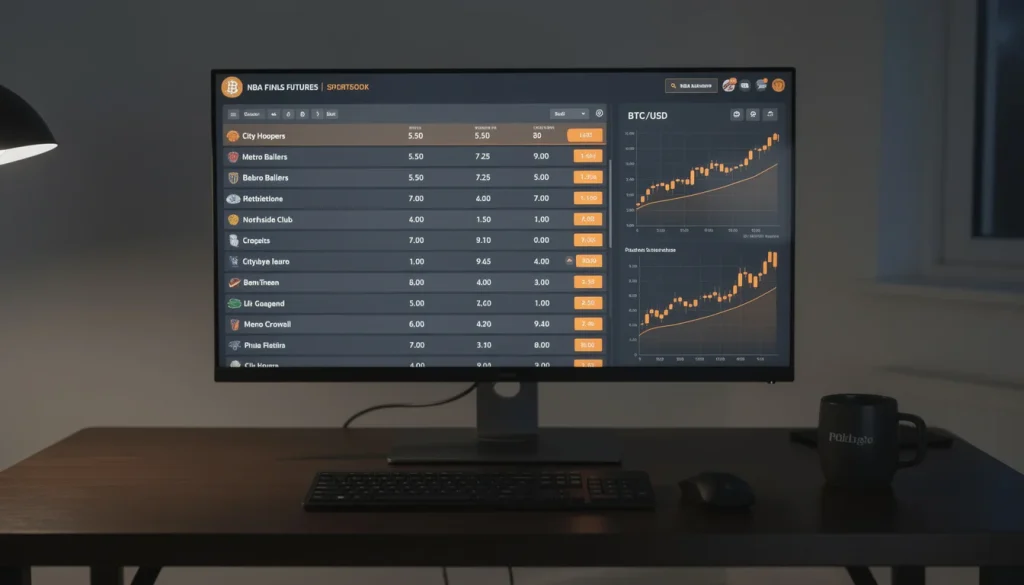
The bet I placed in October 2024 that paid more than the price suggested
In early October 2024 I put 0.005 BTC on Boston to win the 2025 NBA Championship at +650. That stake was worth approximately £325 at the time. When Boston won the title in June 2025, the bet settled at +650 – payout was 0.0375 BTC. But the BTC price had also climbed roughly 60% during those eight months. The actual GBP value of my payout was about £3,800, not the £2,437 the original conversion would have implied. The futures bet won twice: once on basketball, once on currency.
That dual-track payoff is the structural reason long-horizon basketball futures and crypto bankrolls interact in ways that GBP-denominated futures bets don’t. The NBA Finals futures market opens immediately after each year’s championship game and runs nine months until the next playoff bracket determines the actual outcome. Cloudbet’s basketball stakes climbed nearly 100% in Q1 2026 against the same period a year prior, with futures markets absorbing a meaningful share. Mobile cryptocurrency gambling represented 80% of crypto wagers in 2024-25, with Bitcoin’s share rising towards 60%, which means the futures positions accumulating value over months are increasingly running on BTC-denominated balances.
This guide covers what NBA Finals futures actually are, how they differ from conference winner bets, the hedging tools you have when both your bet and your stake currency are volatile, the difference between opening and closing odds, and which crypto operators offer the deepest futures markets.
What an NBA Finals futures bet really is
A futures bet is a wager on a long-horizon outcome that won’t be settled until well after the bet is placed. NBA Finals winner futures open shortly after each year’s championship and run for the duration of the following season – roughly nine months from October’s opening night through the trophy presentation in June.
The prices at the open reflect the bookmaker’s read on each team’s probability of winning the title that season. The 2025-26 season opened with the defending champion priced around +400 to repeat, the strongest contender behind them at +600, and the field stretching out to longshots at +30000 or longer. Those prices are functions of roster, coaching, division strength, injury reports, and the bookmaker’s confidence in their own modelling – and they move as the season unfolds.
The structural feature of futures: the implied probability priced into the line is always above the team’s true probability of winning. The book takes its margin out at the level of the field – the sum of implied probabilities across all teams adds up to 120% or so, not 100%. The margin is the cost of placing the bet, paid in expected value across the field. For futures, that margin is wider than for individual game markets because the variance is higher and the book is holding the money for longer.
Finals winner versus conference winner: where the value usually sits
Two related markets often confuse new punters. Finals winner pays out only if your team wins the championship. Conference winner pays out if your team wins their conference, regardless of what happens in the Finals. The Eastern Conference winner and Western Conference winner together produce one Finals matchup, so betting conference winner is a structurally different bet from betting Finals winner.
The math favours conference winner bets in most cases. If you genuinely think a team is the strongest in their conference, you should bet them as conference winner rather than Finals winner. The price on the conference bet is higher relative to the Finals bet than the implied probability suggests, because the Finals price requires them to also beat the opposite conference’s winner. A team you have at 30% to win the Finals might be at 45% to win their conference – and the price on the conference bet is rarely 45% higher than the Finals bet to reflect that.
The exception: deep longshots. A team priced at +5000 to win the Finals might be +2200 to win the conference. The math on those favours the Finals bet because the additional series win is the part the book is mispricing – they’re protecting themselves on the conference number because longshot conference winners are common, but longshot Finals winners are rare.
Hedging futures positions with BTC denomination
The unique challenge of futures bets in crypto: both your stake and your potential payout are denominated in a volatile currency. A position placed in BTC at $60,000 per coin can shift in implied GBP value by 40% before the bet even settles, regardless of whether the basketball result goes your way. Smart futures betting on a BTC-denominated bankroll requires thinking about both legs independently.
The simplest hedge: split the position. Place half the futures bet in BTC and half in USDT or USDC. The basketball outcome is the same – both halves win or lose together – but the currency exposure is balanced. If BTC drops 30% during the hold, the stablecoin half maintains GBP value; if BTC climbs 30%, you participate in the upside on the BTC half.
The more sophisticated hedge: monitor BTC price against your entry and convert proactively when the position has appreciated meaningfully. If your futures bet has tripled in implied value because BTC has rallied and the basketball outcome looks favourable, converting some of the equivalent value to stablecoin locks in the currency gain without affecting the bet itself. Most crypto sportsbooks let you transfer between balances; the operation costs a small swap fee but preserves the realised value.
For futures held over six to nine months, the BTC currency variance can equal or exceed the basketball variance. Knowing your hedge strategy before you place the bet is part of the bet itself. The mechanics also apply to MVP futures and other long-horizon positions – the BTC-position management is the same logic that applies in NBA MVP futures with Bitcoin where the holding period and the currency exposure run on the same timeline.
Opening odds versus closing odds: timing the futures market
The futures market reprices throughout the season. The opening line in October reflects pre-season expectations. By December, every game played has moved the line. By February’s All-Star break, the line has converged towards what the market thinks will happen, with maybe one or two major surprises still un-priced.
The bets that pay the best are placed at the open, before any in-season data confirms or refutes the pre-season read. The risk is that the bookmaker has correctly priced the team and the line doesn’t move in your favour. The reward is that if you’re right and the team performs above pre-season expectation, the closing price will be significantly shorter than your opening price, and your bet has accumulated paper value through the season.
Andrew Rhodes, the UK Gambling Commission CEO, said in late 2025 about regulatory paths for crypto in UK gambling: “This is going to have to be government level discussion and it is a government level decision because once you open that door, you cannot close it.” That regulatory horizon is part of the futures-bet calculation now. A futures bet placed in October 2026 that settles in June 2027 sits across the FCA’s 25 October 2027 commencement date – the regulatory landscape for the crypto book holding your position may shift before the bet pays out.
Crypto sportsbook coverage of NBA futures
Coverage at major crypto operators is comprehensive for Finals and conference winner markets. The depth on more granular futures – division winners, best regular-season record, players to win awards – varies more. The best basketball-focused crypto books run all of these markets year-round with periodic line updates as the season progresses.
What I look for: stake limits that let me build a meaningful position, fast settlement after the championship, and a balance interface that lets me see the implied current value of my bet (mark-to-market style). Some books show you the live price of your bet during the season; others only show you the original stake until the bet settles. The first kind is more useful for hedging decisions.
Settlement speed matters because Finals futures pay out in June, when crypto withdrawal speeds for UK punters average minutes rather than days. The same withdrawal infrastructure that makes regular-season betting practical makes futures payouts deployable within the same betting session – important if you want to redeploy a winning futures payout into the next season’s opening lines, which themselves open within hours of the championship game ending.
How I’m running my 2025-26 futures book
My current positions: three Finals winner bets placed at varying odds, two conference winner bets, one division winner, one bet on regular-season points-per-game leader, and one MVP futures bet I’ll discuss separately in the MVP-specific guide. All denominated 60% in BTC and 40% in USDT to balance currency exposure.
The total futures position represents about 8% of my basketball bankroll. That’s higher than I’d carry in individual game markets but appropriate for futures because the variance is paid out across many months rather than in single nights. The discipline I maintain: no adding to losing positions, no chasing better lines after losing the original entry, no closing out winning positions early unless the BTC price has moved enough to make the conversion gain worth the transaction cost.
The honest read on futures betting: it’s the slowest possible way to bet basketball and the most patience-intensive. The payoff for that patience is genuine – long-horizon prices have more error than short-horizon prices because there’s more uncertainty for the bookmaker to model. The BTC-denominated layer adds a second source of variance that experienced crypto punters learn to manage and inexperienced ones get caught by. The bets I look back on as best-value are almost always opening-line bets placed in October with conviction and held through to settlement without flinching at the inter-season swings.
When do NBA Finals winner odds open at crypto sportsbooks?
Most crypto sportsbooks open Finals winner odds within 24-48 hours of the previous championship game ending. The opening lines reflect off-season expectations and are usually softest in the first two weeks before in-season data starts moving the prices. The strongest value typically lives in the immediate post-championship window.
How do I hedge a futures bet placed in BTC if the price triples?
The cleanest hedge is to convert an equivalent value of your sportsbook balance from BTC to USDT or USDC. The bet itself stays BTC-denominated, but the realised gain on the currency leg is preserved. Some operators let you split a futures bet across multiple stake currencies at placement, which builds the hedge in from the start.
Articles
Created by the "Bitcoin Basketball Bets" editorial team.
