
NBA Value Betting with Bitcoin: Finding +EV Spots at Crypto Sportsbooks
 Available in US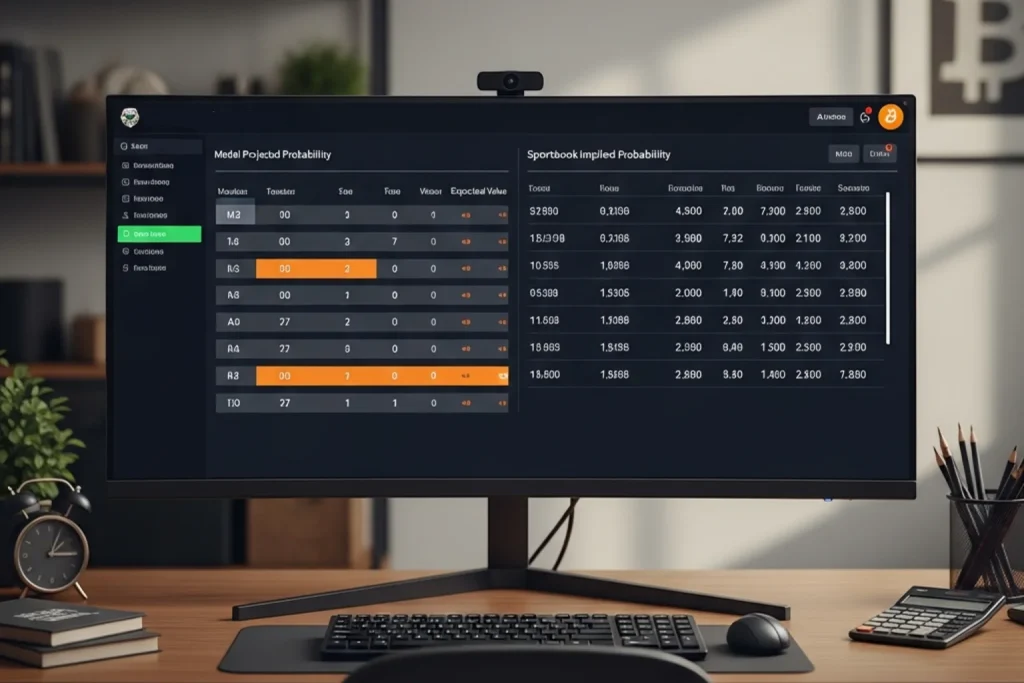
The spreadsheet that turned my NBA betting into a business
Until about 2021 I was betting NBA on instinct, with model fragments held loosely in my head, and a vague sense of which operators offered better lines on which teams. Then I built a closing-line-value tracker in a spreadsheet, started logging every settled NBA bet with the line I took versus the closing line, and within three months I had clear evidence about what was actually working and what was variance. Value betting isn’t a mystical concept – it’s the disciplined application of probability mathematics to a sportsbook menu where the operator margin is the cost of entry and line dispersion across operators is the opportunity.
UK crypto sportsbooks are a productive environment for NBA value betting in 2026 because line dispersion across the major operators is wider than across UK-licensed fiat books, the menus are deeper, and BTC settlement speed makes capital recycling between bets faster. This guide covers what a value bet actually is, how to measure closing line value, why crypto books often run softer NBA lines than fiat alternatives, the tools and records you need, and the bankroll implications of a value-betting approach.
What is a value bet, really
A value bet – or +EV bet (positive expected value) – is any wager where the bettor’s estimated probability of winning, multiplied by the payout, exceeds the stake. The maths is simple: if you think a team has a 55% chance of covering -4.5 and the line is offered at 1.95 odds (implied probability 51.3%), you have a 3.7% edge per bet. Over a large sample, that edge translates to consistent positive returns regardless of any individual game’s outcome.
The hard part isn’t the maths – it’s the probability estimate. Knowing whether your 55% is genuinely 55% or whether it’s an overconfident guess driven by recency bias, narrative thinking, or selection effects in your data is the substance of the value-betting discipline. The bettors who succeed at this over years are the ones who keep records, measure their predictions against outcomes, and adjust their models when the evidence demands it.
The market is your benchmark. If you consistently bet at prices that the closing line moves towards (you took -4.5, the line closed at -5.5, you’re “beating closing”), you’re finding value the market eventually agrees with. If your bets consistently close at the same price you took or worse, your probability estimates aren’t beating the wisdom-of-crowds pricing that the operator’s line represents. Closing line value (CLV) is the cleanest single proxy for whether you’re finding genuine edge.
Closing line value: the measurement that matters most
CLV is calculated for each settled bet as the difference between the price you took and the price the market closed at, expressed in implied probability or odds-equivalent terms. A bet you took at 2.00 that closed at 1.85 (the line moved against you, suggesting the market now considers your team more likely to win) has positive CLV. A bet you took at 1.85 that closed at 2.00 has negative CLV – you bought into a price the market subsequently revised away from.
For NBA spread bets, the calculation is straightforward. You took Lakers -5.5 at -110 (1.91). The closing line was Lakers -7 at -110. The market moved a full 1.5 points towards your team, which represents roughly 6% in implied probability. That’s strong CLV. You took the same line at the same odds and it closed at Lakers -4 at -110 – the market moved 1.5 points away from your team, negative CLV of similar magnitude.
The bettor who consistently records positive CLV across a sample of 200-500 NBA bets is genuinely finding edge, even if short-term P&L is variance-driven. The bettor with consistently negative CLV is losing edge to the market regardless of whether they’re winning or losing on the surface. CLV is the leading indicator; P&L is the lagging indicator with high noise.
The implementation: log every NBA bet with date, operator, market, line, odds, stake, and closing line. After settlement, calculate CLV and tag the bet by market type. After 200+ bets, you’ll have actionable data on which market types are producing your edge and which are leaking it. This is the single highest-value analytical work a serious UK NBA bettor can do.
Why crypto sportsbooks run softer NBA lines than fiat alternatives
The structural reason crypto sportsbooks run softer NBA lines than UK-licensed fiat books on average is volume composition. The biggest fiat NBA operators (DraftKings and FanDuel in the US, regulated UK operators serving the British market) have such heavy NBA action that their pricing engines are essentially calibrated to the collective wisdom of high-volume professional bettors. Their closing lines are extremely efficient on the main NBA markets.
Crypto sportsbooks have lower NBA-specific volume relative to their overall handle. Stake.com generated $4.7 billion in GGR in 2024 across all sports and casino offerings, but NBA-specific basketball wagering is a smaller proportion of that handle than at the NBA-focused fiat operators. Cloudbet’s Q1 2026 market report showed basketball wagering doubled year-on-year on the platform – fast growth, but from a lower base than the dominant fiat books. The lower NBA-specific volume means crypto book pricing engines have less professional action calibrating them, which produces slightly softer lines.
The advantage for the disciplined UK bettor is real but bounded. The crypto books aren’t dramatically softer – the gap on main markets (spreads, totals, moneylines) is typically 0.5-1 cent on the dollar across operators, not the 5-10 cents that “soft lines” rhetoric sometimes implies. The bigger gap is in the secondary markets: alternative spread ladders, period totals, player props for mid-rotation players, and live in-play markets. These are where the line-shopping edge for a UK bettor is concentrated.
The other crypto-specific factor: the operators with the softest lines tend to be the ones running aggressive customer acquisition campaigns. Operators in scaling phase (adding NBA-region marketing, expanding markets) often run softer lines to attract volume, then tighten as scale arrives. Cloudbet has been in this phase through 2025-2026, which is why the basketball growth numbers are so strong and the line quality has been competitive for value-seeking bettors.
Tools and records for serious value betting
The minimum analytical toolkit for a UK NBA value bettor is a bet-tracking spreadsheet with CLV calculations, a model (or multiple models) for predicting NBA outcomes that you can compare to operator lines, a line-shopping discipline across 3-4 operators, and a settlement record sufficient to support tax-adjusted P&L analysis if you’re operating at meaningful stakes.
The spreadsheet is non-negotiable. Every settled NBA bet logged with: date, fixture, operator, market type, line taken, odds taken, stake, closing line, closing odds, settlement result, P&L. After 100 bets, run a pivot table by market type to see where your CLV is concentrated and where you’re leaking edge.
Model construction is the deeper investment. A basic NBA model can be a regression on team efficiency ratings adjusted for pace and home court. A more sophisticated model adds player-level adjustments, rest factors, schedule density, injury impact, and matchup-specific defensive considerations. The bettors who beat the closing line consistently are usually running model outputs against the operator line and only betting when the gap exceeds a threshold that accounts for operator margin.
Line shopping is the cheapest source of edge available. Maintaining accounts at 3-4 crypto sportsbooks and checking each before every bet adds 3-5 minutes to placement time but produces measurable EV gain across a season. The operators worth comparing are Cloudbet, Stake, BC.Game, and Sportsbet.io for general NBA markets, with Cloudbet typically tightest on points props and Stake deepest on second-tier player props.
Bankroll implications and stake sizing
Value betting only works at appropriate stakes for your edge size. A bettor with a genuine 3% edge over hundreds of bets makes money slowly and with significant variance; the same bettor over-staking on perceived 10% edges will go broke through variance even when the edges are real. Kelly criterion (or fractional Kelly) is the standard framework for sizing stakes based on edge size and bankroll, and any serious UK value bettor needs to be comfortable with the underlying maths.
For most UK punters, fractional Kelly (typically quarter-Kelly or half-Kelly) is the appropriate sizing approach. Full Kelly maximises long-run growth but the variance is brutal and the consequence of model error is severe. Quarter-Kelly sacrifices some growth for substantially lower variance and is more forgiving of probability estimation errors. The maths: if Kelly suggests a 4% bankroll bet, quarter-Kelly is 1% of bankroll on that position.
The crypto sportsbook environment supports stake sizing discipline because the BTC denomination keeps the maths visible. A bettor working in BTC with a 0.5 BTC bankroll and a 1% quarter-Kelly position size is staking 0.005 BTC per bet – clear, calculable, easy to monitor. The full bankroll mechanics interact with the cross-operator pricing differences that crypto books exhibit relative to fiat – the structural pricing comparison between the two market structures sits in the crypto vs fiat basketball odds guide, and reading both gives you the toolkit to understand where your edge is coming from and how to size against it.
The value-betting trajectory across a UK punter’s NBA career
The UK punter starting on the value-betting path in 2026 should expect a 6-12 month learning curve before the discipline produces consistent results. The first 100 bets are about establishing the tracking infrastructure and identifying which market types your model is genuinely beating. The next 200 bets are about refining the model and tightening the line-shopping discipline. After 500 settled bets with consistent positive CLV, you have actionable evidence of edge and can size up accordingly.
The bettors who succeed at value betting over years aren’t the ones with the most sophisticated models – they’re the ones with the most consistent record-keeping and the discipline to fold when their CLV deteriorates. The crypto sportsbook environment in 2026 is structurally favourable because the menus are deep, line dispersion is meaningful, and settlement speed enables faster capital recycling. A UK punter who commits to value betting as a serious discipline has the infrastructure to make it work; the variable is the discipline itself.
How is closing line value calculated for an NBA crypto bet?
CLV is the difference between the price you took and the price the market closed at. For an NBA spread bet you took at Lakers -5.5 with the line closing at Lakers -7, the market moved 1.5 points towards your team – that"s positive CLV of roughly 6% in implied-probability terms. For a moneyline bet you took at 2.10 that closed at 1.95, the implied probability moved from 47.6% to 51.3%, a positive CLV of 3.7%. The calculation is the same regardless of crypto or fiat denomination – what matters is the line and odds, not the settlement currency. Log every bet with the placement line and closing line and you can calculate cumulative CLV across your sample, which is the cleanest single proxy for whether you"re finding genuine edge.
Are crypto sportsbooks really softer than UK fiat books on NBA spreads?
On main markets (spreads, totals, moneylines) the gap is real but small – typically 0.5-1 cent on the dollar across operators, not the dramatic gap that "soft lines" rhetoric sometimes suggests. The reason is volume composition: major fiat books like DraftKings and FanDuel have such heavy NBA-specific volume that their pricing engines are calibrated to professional action and produce highly efficient closing lines. Crypto books have lower NBA-specific handle relative to overall volume, which leaves slightly more room for line dispersion. The bigger gap is in secondary markets – alternative spread ladders, period totals, player props for mid-rotation players, live in-play markets – where the line-shopping edge for a UK bettor is most concentrated and where crypto books can be materially softer than fiat alternatives.
Articles
Created by the "Bitcoin Basketball Bets" editorial team.
