
NBA Game Props Bitcoin Betting for UK Punters
 Available in US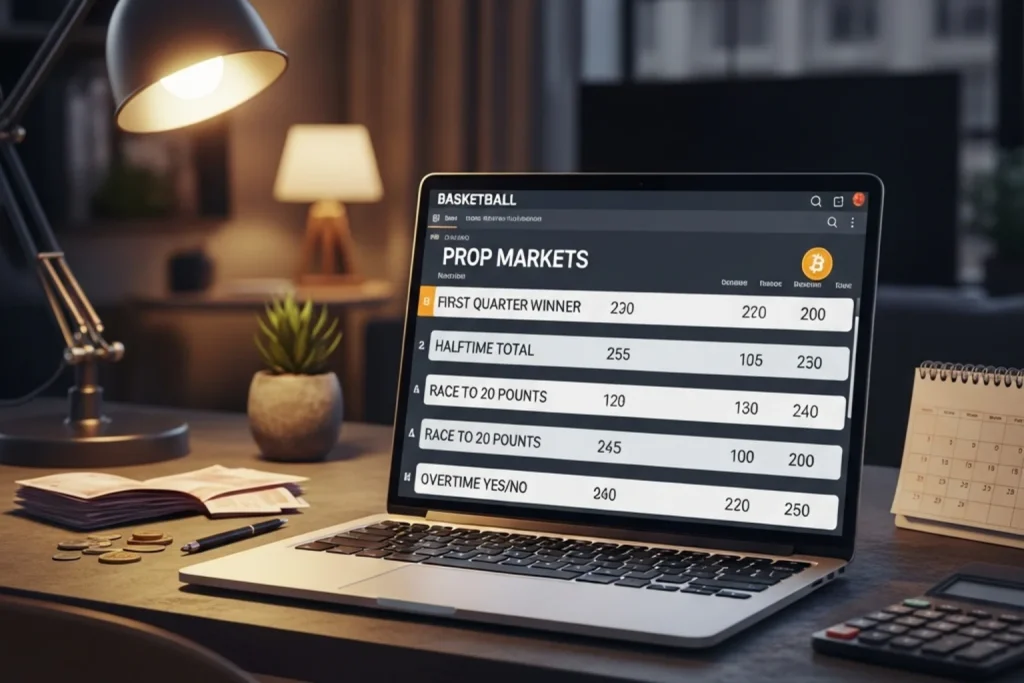
Pricing Alternative NBA Betting Markets
Most NBA viewers will tell you the game ended when the buzzer went and one team was up. Most NBA bettors will tell you the game contains thirty other questions, each with its own price. A game prop is a bet on something happening inside the match that doesn’t depend on which team wins – first-quarter winner, will there be overtime, will the combined three-point total cross 28. The match result is the headline. The game props are the rest of the story.
This is the market where crypto sportsbooks have aggressively expanded over the last eighteen months, because basketball stakes have grown by close to 100% at major crypto books and the simple moneyline-and-spread board can’t absorb that volume. Game props are where the new depth lives. They also sit at the heart of why live in-play betting now holds the largest share of revenue across the global sports-betting market – most live action runs on prop and micro markets rather than the headline lines.
This guide separates game props from the more familiar player props, walks through the first-quarter and overtime markets in detail, covers the Bitcoin-specific limits you’ll hit on niche markets, and lays out where the edge actually sits – because game props are also where the house margin is widest, and that’s where punters lose money quickest if they’re not paying attention.
Game props vs player props: the line that matters
A game prop is about the match itself: total three-pointers in the game, will there be overtime, race to 20 points, margin of victory bands, first team to 30. A player prop is about an individual: LeBron over 24.5 points, Jokic over 11.5 rebounds, Curry to make 5 or more threes. They sit in different sections of the bet menu at almost every crypto sportsbook, and they reward different reads.
Game props reward team-level reads – pace, defensive scheme, coaching tendency, bench depth. Player props reward player-level reads – usage rate, injury report, matchup against a specific defender. The two markets often correlate (a high-pace game will produce more player-prop overs), but the analytical approach to each is different enough that mixing them in one ticket is usually a parlay mistake.
The way to think about whether a market is a game prop or a player prop: if the answer depends on which players are on the floor in the closing minutes, it’s a player-driven question. If the answer is mostly settled by the way both teams play as a unit, it’s a game prop. The crossover cases – total assists in the game, total turnovers – are technically game props but heavily influenced by which players hold the ball. Treat them as hybrid markets and price them with both lenses. The full breakdown of player-specific markets, including how injury news moves prices, lives in the NBA player props guide.
First-quarter markets and the data they hide
First-quarter markets are the most underused tool in the NBA betting kit. They include first-quarter winner, first-quarter spread, first-quarter total, race-to-20 between the two teams, and on some books, first basket scored. The limits are smaller than full-game markets – typically 30-50% of the main board’s max – and the prices are slightly wider on margin, but the structural feature that makes them tradable is information asymmetry around starting lineups and rotations.
The first quarter is the only stretch of an NBA game where you know with high confidence which players will be on the floor. By the second quarter, bench rotations have begun and the assumed minutes plan starts colliding with foul trouble and matchup adjustments. First-quarter markets reward punters who pay attention to which starters are playing in front of which defenders, especially in the opening eight minutes before the first substitution.
First-quarter totals have a structural tilt towards the under that I’ll trust until proven otherwise. Teams in the first quarter tend to run scripted offence – set plays drawn up the night before – which produces a steadier scoring rate than the wider-variance possessions that come later. The total typically prices around 26% of the full-game number, which often slightly overshoots the historical first-quarter share of about 24-25%. That gap is small per bet and meaningful across a season of selective unders.
The trap with first-quarter markets is over-betting them. The limits are smaller and the noise per bet is higher; a single rebound that swings a transition basket can flip the outcome on a 12-minute sample. Treat them as supplements to a main-board ticket, not the main course.
Overtime yes/no and why the price moves before tip-off
The overtime market is binary: will the game require an OT period or not. The default no-OT price is usually around -300 to -400, because the base rate of NBA games hitting overtime sits at about 6-7% per game across a season. The yes-OT price is typically +220 to +260 depending on the book. Both numbers move based on how tightly the two teams have been priced – a coin-flip game at -110 either way will have the overtime price drift to maybe +200 because close games go to OT more often than blowouts.
Where the OT market gets interesting is the late-line move. About 90 minutes before tip-off, the OT yes price tends to tighten because that’s when starting-lineup news drops. If a star is ruled out and the spread widens, the OT yes price drifts longer – blowouts almost never produce overtime. If a star is unexpectedly active and the spread tightens, the OT yes price contracts.
The contrarian play exists in the opposite spot. A tight-line game between two teams that both excel at closing out fourth quarters – strong free-throw shooting, capable late-clock defenders – actually goes to OT less often than the base rate would suggest. Books sometimes price OT yes a touch generously on tight lines as a result. It’s not a free shot, but it’s the closest the OT market gets to one. Track which games hit OT across a month and you’ll start to see the structural patterns underneath the headline 7% rate.
Bitcoin limits and why niche game props get capped
Every crypto sportsbook imposes lower limits on niche game props than on the main board. There are two reasons for this and they’re worth understanding before you slam a big stake on a first-quarter spread and find the book has scaled you down by 70%.
First, exposure management. The main moneyline and spread markets have deep two-sided action – for every backer of one side, there’s a backer of the other. Niche props are one-sided more often; the book takes on real positions and limits the size to keep that exposure manageable. The smaller the market, the lower the max per-bet limit. A standard NBA spread might max at 1 BTC; a first-quarter spread might max at 0.1 BTC; a same-quarter race-to-20 might max at 0.02 BTC.
Second, on Bitcoin-funded books specifically, the operator carries currency exposure on every open position because the line was priced in dollars or pounds but the stake is in coin. The longer a position is open, the more BTC-price risk the book is sitting on. Pre-game game props are typically settled within hours of placement, which keeps exposure short. Futures-style game props – total games over X across a series – are kept at lower limits because the position sits open for days or weeks while BTC moves.
The practical consequence is to size game props at the limit you’ll actually be allowed, not the limit you’d theoretically want. Trying to put a full unit on a niche market often results in a partial fill or a request to verify, which slows everything down and sometimes triggers an extra review. Stay under the obvious cap and the book leaves you alone.
The mistakes that cost more than the markets earn
The biggest mistake on game props is treating them as parlay fuel. The implied probabilities multiply, the margins compound, and what looks like a +600 ticket on three correlated first-quarter outcomes is paying you maybe 60% of fair value once you do the math. Books love these parlays because the combined house margin sits at 12-15% per ticket. They’re not always a bad bet; they’re almost always a worse bet than the same legs played individually.
The second mistake is mistaking volume for edge. A punter who lays five game props per game on six games a night has placed 30 bets – each with a 5-7% house margin – and gone home thinking the night was unlucky when the result was largely arithmetic. Game props reward selection, not volume. If you can’t articulate why this specific market on this specific game is mispriced, the bet isn’t there.
The last mistake is closing-line laziness. Game props move late. The first-quarter line at noon UK time is rarely the same line at tip-off. If your read justified the bet at noon, the move into tip-off either confirmed it (the line moved your way and you’re now beating the close) or contradicted it (the line moved against you and you should have placed earlier). Track that gap – beating-the-close on game props is the cleanest signal you have that your read is real and not a coin flip.
Which NBA game props give crypto sportsbooks the smallest margin?
The first-quarter total and the full-game total three-pointers tend to carry the tightest margins at major crypto books – typically 4-5%, similar to the main spread. Race-to-20 and margin-of-victory bands run wider at 7-8%. The OT yes/no market sits in the middle. As a rough rule, the more frequently the market is traded, the tighter the margin; niche props that get bet a few hundred times a week carry house margins of 10% or more.
Why are first-quarter markets limited at most Bitcoin sportsbooks?
First-quarter markets carry higher per-bet variance for the book because they settle on a 12-minute sample, and they attract sharper punters who track lineup confirmations carefully. Both factors push books to set lower per-bet caps – typically 30-50% of the main board limit. The limits also reflect that Bitcoin-denominated exposure is more sensitive to short-horizon coin price moves than fiat-denominated exposure would be.
Articles
Written by the editors at Bitcoin Basketball Bets.
