
NBA Moneyline Betting with Bitcoin in the UK
 Available in US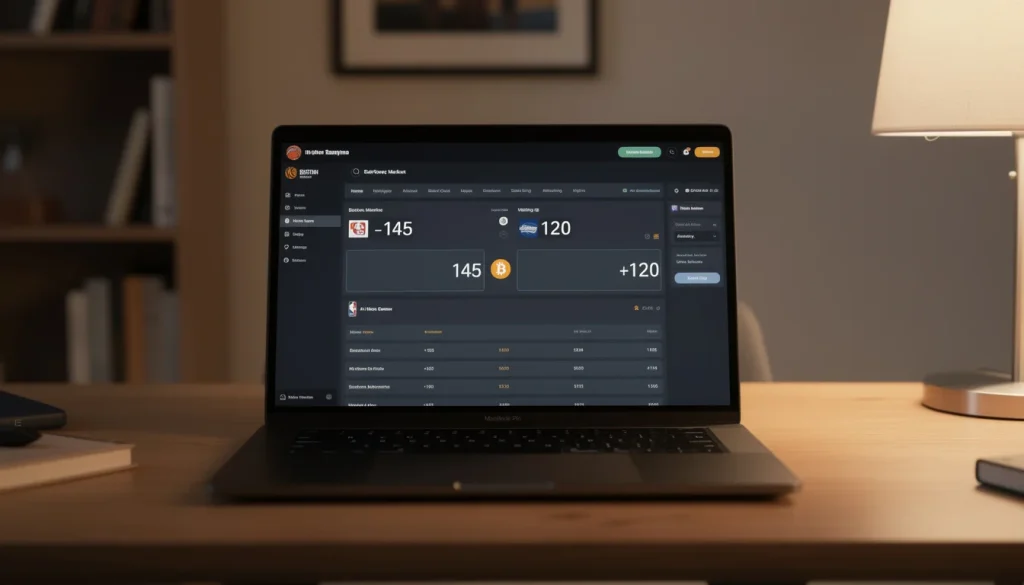
Core Advantages of Crypto Moneyline Markets
My first NBA bet in Bitcoin was a moneyline. Boston at home against a mid-table Western team, decent line, half a satoshi at risk. The point of starting there wasn’t laziness – it was clarity. A moneyline is a win-only outcome: one team wins, your bet wins, the score margin is irrelevant. No half-points, no pushes, no recalculation when a buzzer-beater nudges the total. For a UK punter walking into a crypto sportsbook for the first time, that simplicity is the closest you’ll get to a controlled experiment.
The reason moneyline matters in 2026 isn’t novelty – it’s volume. Cloudbet’s Q1 2026 market report showed basketball stakes climbing by almost 100% against other sports, with average ticket size beating football. That growth runs through the simplest market first because that’s where new money goes. Before parlays, props or live in-play, punters test a book on a single straight pick. If the book settles fast, pays in coin and doesn’t lose the line, they come back.
This guide walks through how a moneyline works, how American and decimal prices read against each other, what a real Bitcoin-funded NBA bet looks like end to end, and the conversion math that catches most newcomers out. The goal is one bet you can place cleanly – and understand exactly why it paid what it did.
After mastering straight wagers, the next logical step is learning how NBA point spread Bitcoin betting can offer better value on heavy favorites.
How a moneyline actually settles, from tip-off to payout
Picture the screen: Lakers -180, Wizards +160. That’s it. Bet £100 on Lakers at -180, you risk £180 to win £100 – total return £280 if they win. Bet £100 on Wizards at +160, you risk £100 to win £160 – total return £260. No spread, no totals, no overtime adjustment beyond the standard “OT counts” rule almost every book uses by default.
The negative number always means the favourite – you put more in than you get back if it wins. Positive means the underdog – you risk less than you stand to win. UK punters used to fractional odds (5/4) or decimal (2.25) see those numbers as the same probability dressed differently. American prices feel awkward at first; they stop feeling awkward roughly the third time you read them.
Where it gets interesting at a crypto book is what happens after settlement. At a fiat UK sportsbook, your winning balance sits there as a number you withdraw via Faster Payments. At a Bitcoin book, the winnings post in BTC or whatever stablecoin you funded with. The line, the stake and the payout all exist as crypto from the moment you click Place Bet. The fiat number you see on screen is a display preference; under the hood, everything is denominated in coin.
That distinction matters because the moment your bet settles is the moment your exposure to coin price changes – not just to the team you backed. If you want to step beyond a single win-only outcome, the natural next stop is the NBA point spread market, where the line itself does some of the heavy lifting and the maths gets a notch more interesting.
American, decimal and fractional odds, side by side
Most UK readers learned to bet in fractional – 5/4, 11/8, evens. Then the apps shifted everyone to decimal because it’s faster to multiply. Crypto sportsbooks, almost without exception, default to American odds because they’re built for a global market with NBA as the anchor product. You’ll see decimal as an option in settings, but the line you land on for the first time is going to be -110, +145, -220.
Quick conversion that I keep in my head and you should too. A negative American price: take 100, divide by the price’s absolute value, add 1. So -150 becomes 100/150 + 1 = 1.667 in decimal, which is 4/6 fractional. A positive American price: divide it by 100, add 1. So +180 becomes 180/100 + 1 = 2.80 decimal, or 9/5 fractional.
Implied probability is the part most punters skip and shouldn’t. At -150, you’re paying for a 60% implied win rate. At +180, the implied is 35.7%. Add the two sides of a moneyline together and the total exceeds 100% – that excess is the book’s margin, the overround. On NBA moneylines, healthy crypto books run around 4-5% combined margin on the two-way line. Anything north of 7% tells you the book is either soft on data or aggressive on take.
The practical use of implied probability is simple: if you think a team’s true chance to win is higher than the implied number on offer, you have a positive expected value play. If it’s lower, you don’t. Most punters bet on names and storylines; sharp ones bet on the gap between the implied number and their own.
A worked example: Boston Celtics vs Memphis Grizzlies in Bitcoin
Here’s a real-shape example. Celtics host the Grizzlies on a Wednesday night, tip-off 1:30 GMT for the UK audience. The screen shows Boston -185, Memphis +160. You like Boston, you fund your book in Bitcoin, and you’ve decided your unit is 0.005 BTC – roughly £200 at the rate you bought in.
You place 0.005 BTC on Boston at -185. The book locks in the line, the price and the satoshi amount. Risk: 0.005 BTC. Potential return: 0.005 × (100/185 + 1) = 0.005 × 1.5405 = 0.00770 BTC, which is your stake back plus 0.00270 BTC of profit. If Boston wins, your balance moves from 0.0050 BTC pre-settlement to 0.00770 BTC post-settlement. If Memphis wins, you lose the 0.005 BTC and the bet is done.
Boston wins by nine. The settlement happens automatically – most crypto books push the balance update within sixty seconds of the final whistle. The on-screen GBP value of your winnings depends on what BTC is doing at that moment. If BTC was £40,000 when you placed the bet and £40,200 at settlement, your 0.00270 BTC profit is worth £108.54 instead of £108.00 – a tiny tailwind. If BTC dropped to £39,500, the same 0.00270 BTC is £106.65 – the team won but the asset moved against you.
That’s the unfamiliar part for punters arriving from fiat: you can win the bet and still see less fiat in your wallet, or lose the bet and have the surviving coin appreciate. The team result is binary; the coin price is continuous. You’re not getting away from this by switching to a stablecoin balance, you’re just trading one risk profile for another.
The conversion math that decides how much you actually keep
The number on the ticket isn’t the number you keep. Two layers sit between settled crypto and spendable GBP: book-side conversion drift, and exchange-side withdrawal cost. Both are small per transaction and large over a season.
On the book side, the line you took was probably displayed in dollars or pounds for comfort, but the bet was sized in coin. If you funded 0.05 BTC and bet 0.005 BTC chunks, the GBP-equivalent of each stake varies with the BTC chart. A flat 0.005 BTC bet today and the same 0.005 BTC bet next week can represent very different real-money risk. Most disciplined crypto bettors I know either rebalance to a stablecoin balance weekly or accept the drift as part of holding the asset.
On the exchange side, withdrawing BTC to a UK exchange and converting to GBP costs you a network fee, an exchange spread and a small slippage. None of this is exotic – it’s the same friction every UK crypto holder pays. The point is to count it. A 1% all-in conversion cost on a £1,000 monthly betting cycle is £120 a year of pure leakage. That’s a real bite into the edge you’re trying to extract from soft NBA lines.
The cleanest fix is batching. Withdraw less often, in larger amounts. Pay the network fee once a fortnight instead of after every winning bet. The fee is a flat cost; the percentage shrinks the more you put through it.
What discipline looks like when your bankroll is volatile
The mistake I see new crypto punters make is sizing in coin and never re-checking the GBP exposure. They started with 0.05 BTC at £40,000 – that’s £2,000. Three months later BTC is at £55,000 and their “same stake” of 0.005 BTC is now £275 instead of £200. They didn’t decide to bet more; the asset decided for them. Then one losing run feels disproportionate, and they cut sizes mid-streak, which is the worst possible reaction.
The fix is anchoring stakes to a GBP-denominated unit and recalculating the coin amount once a week. If your unit is £100, the coin equivalent floats with the BTC price; the real-money risk per bet stays steady. It’s not glamorous, it’s not hodler ideology, and it’s the only way to keep moneyline volume profitable across a six-month season where BTC can swing 30% either way.
The second rule is just as boring. Never chase a losing moneyline streak with bigger stakes. NBA moneylines lose more often than people remember – at -200 odds you’re winning roughly two in three at break-even, which means three-bet losing runs happen ten times a season minimum. Sizing assumes losing runs. If yours doesn’t, you’ll find out the hard way.
Treat moneyline as the foundation, not the destination. It’s the bet you place when you have a strong, simple read on a game. The rest of your volume should be deliberate – spreads when the line moves, totals when the pace read is clear, futures when you’re paid for being patient. Win-only is a tool, not a strategy.
Always compare the daily lines at a top-rated crypto sportsbook for basketball to maximize your returns.
How do American moneyline odds translate to UK decimal odds?
For a negative price, divide 100 by the absolute number and add 1: -150 becomes 1.667 decimal. For a positive price, divide the number by 100 and add 1: +180 becomes 2.80 decimal. Most crypto sportsbooks let you switch the display in settings, so you don"t have to convert in your head once you"ve set the preference.
What is the minimum Bitcoin amount for an NBA moneyline bet?
Most crypto sportsbooks set minimums in the 0.0001-0.0005 BTC range for sports markets, which is roughly £4-20 at 2026 prices. The minimum varies by book and sometimes by market; live in-play minimums are usually a touch higher than pre-game. Check the bet slip before you confirm, because the displayed GBP equivalent can lag the live coin price by a few seconds.
Articles
Created by the "Bitcoin Basketball Bets" editorial team.
