
Live NBA Bitcoin Betting Markets for UK Punters
 Available in US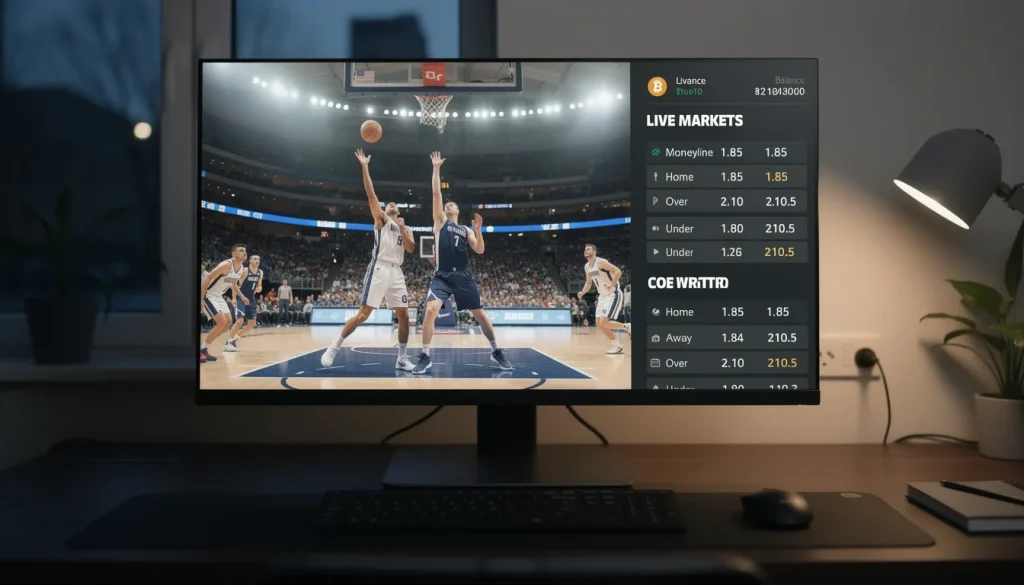
Navigating Fast-Moving NBA In-Play Markets
The first time I tried to live-bet an NBA fourth quarter with Bitcoin, I cost myself a winning ticket. Score was tied with two minutes left, the live spread flipped from one team to the other, and I sat watching with a half-formed read instead of acting on it. By the time I clicked, the line had moved past my number. The bet would have won. The opportunity didn’t.
Live in-play betting now produces the largest share of revenue across the global sports-betting market, and inside the NBA it’s the segment growing the hardest. Crypto sportsbooks have leaned into this because their tech stack – instant deposit confirmation, instant settlement – fits the rhythm of live wagering better than fiat banking infrastructure does. With mobile betting projected to account for 80% of all crypto gambling by 2026, the entire live experience is being built around a phone screen and a fast settlement layer.
This walkthrough covers what live betting is in NBA terms, the in-play markets that exist on a typical crypto book, the feed latency that catches first-time live bettors, why depositing mid-game is almost always a mistake, and how cash-out mechanics work when both your stake and your exit are in coin.
Live betting in the NBA, without the marketing gloss
Live betting means placing a wager after tip-off, on markets that update continuously as the game unfolds. The book runs a real-time model: every made basket, every defensive stop, every timeout shifts the implied probabilities and the displayed prices. A live spread on a game tied at the half is not the same number as the pre-game spread; it’s a fresh line calculated from the score, the time remaining and a pace model running on the live data feed.
The structural feature that makes NBA suited to live betting is the pace. There’s a scoring action roughly every 14-16 seconds of game clock, which means the market needs to recalculate constantly. Compare that to football, where ten minutes can pass with the line essentially static. NBA live markets shift every few seconds and reopen after every dead ball.
The shape of the in-play menu typically includes live moneyline, live spread, live total, live quarter and half markets, micro-markets like “next team to score” or “result of the next possession”, and live player props that update after the player’s most recent shot attempt. Limits on live markets are usually 30-60% of pre-game limits, because the book is taking on positions in real time and managing exposure tighter as the game progresses.
Tim Miller, executive director of research and policy at the UK Gambling Commission, said the regulator wants to start examining “what the potential path forward would be to create a way for cryptoasset to be used as a consumer payment option for licensed and regulated gambling in Great Britain”. That’s a long-horizon statement – the FCA’s new cryptoasset regime sits at October 2027 – but it explains why crypto live betting in the UK still runs through offshore books, not domestic ones. The licensed UK market simply hasn’t caught up to the product shape that crypto operators have built around live in-play.
The in-play markets you’ll actually use
The live spread is the workhorse. A pre-game spread of Lakers -6 might sit at Lakers -2 in the middle of the third quarter if Boston has cut the lead. That’s the market telling you that the remaining game time, given the current score and pace, prices Lakers as a smaller favourite than they were pre-game. If you think the closing minutes will swing back to Lakers, the live -2 is a structurally different bet from the pre-game -6 and prices accordingly.
The live total is the second most-used market and the one most punters get wrong on. A game running ahead of pace projection at halftime – 116 combined at the break against a pre-game total of 224.5 – will have the live full-game total jump to 235 or higher. The naive bet is to chase the over because “they’re scoring”. The structural bet, often, is the live under, because second halves regress towards the projected pace as bench rotations come in and tired legs play half-court. Not every game does this, but the regression pattern is real enough to track.
Live moneyline shifts hardest in the fourth quarter. A team trailing by six with three minutes left will see their moneyline drift to +180 or +200; a tied game with thirty seconds left can have the leading team at -150 or worse. These are the markets where the pre-game decision tree from the NBA quarter and half betting guide converts most directly to live opportunities – period-specific reads inform which fourth-quarter line is mispriced relative to the actual closing dynamic.
Micro-markets – next possession outcome, next made three-pointer – exist on most crypto books but they’re noise. The margins are 15%+, the limits are tiny, and the implied edge a punter would need to overcome them is unrealistic. They’re product features, not value markets.
Latency, feed delay and the lag you can’t control
Every live betting platform runs on a data feed sourced from the official NBA data provider. That feed updates within a fraction of a second of the actual game event. Your TV broadcast, by contrast, runs at a 5-10 second delay against the live data – sometimes more in the UK on certain streaming services. The book’s prices update with the data, not with your TV.
The practical consequence is that what you just saw on screen is already priced into the line by the time you’ve reached for your phone. If LeBron just made a three on your TV, the live moneyline you’re staring at has already moved against that team’s opponent. You’re not getting in early on the move; you’re already late.
There’s a secondary lag that matters too: market suspension. After every made basket, fouled-shot situation, or significant change in possession, the book briefly suspends live markets while the model recalculates. That suspension is usually 5-15 seconds. If you click during a suspension, the bet won’t accept. If you click just as the market reopens, the price you’re staring at might already be moving by the moment your bet hits the book’s server. Some books accept the price you saw if it moved within a small tolerance; others reject the bet entirely with a “price changed” notification.
The way experienced live bettors handle this is to pre-decide their action before the suspension. Watching a game, building a thesis – “if it gets to a tie with under three minutes left, I want Lakers live moneyline at +100 or better” – and then waiting for that specific market state. When the conditions arrive, the click is mechanical. The latency hurts you when you decide and click in the same five-second window; it stops hurting you when you decide first and only click on a market you were already waiting for.
Mid-game deposits and why they almost always cost you
The biggest unforced error I see in live crypto betting is mid-game deposit. The thinking goes: I’m watching the game, I have a strong read on the next 90 seconds, let me top up my balance with another 0.01 BTC and place the live bet. The problem is that an on-chain BTC deposit takes 10-30 minutes minimum to credit, and an Ethereum or stablecoin deposit isn’t materially faster once you account for network confirmations and the book’s internal credit cycle.
By the time the deposit is credited, the live market has moved on. The price you wanted is gone. The bet you’d planned doesn’t exist anymore. You’re now sitting on a balance you funded for one purpose and you find yourself looking for any bet to justify the deposit – which is exactly the spot where discipline collapses and chase-betting starts.
The fix is structural: only live-bet on a pre-funded balance. Decide in advance what your live-betting bankroll is for the week, pre-fund it, and don’t add to it mid-game under any circumstance. If you run out of bankroll mid-game, the game’s over for you. The deposit you’d add to chase one more bet is almost always a worse bet than the ones you’ve already passed up.
The same logic applies to the Lightning Network or any fast layer-2 option that books support. Even with sub-minute confirmations, the live market is moving faster than your top-up. The structural rule “pre-fund, never mid-game fund” is independent of how fast the network is.
Cash-out, partial cash-out and the price you actually get
Cash-out is a feature most crypto sportsbooks offer on live bets and on some pre-game bets after the game starts. The book offers you a price to close your position before settlement – a partial profit on a winning ticket, or a partial recovery on a losing one.
The cash-out price the book offers is not fair value. It includes a haircut – typically 10-15% on a live spread or moneyline mid-game, often more on a parlay. If your pre-game Lakers +6.5 is sitting at Lakers up 4 with two minutes left, the fair-value cash-out for your stake would be roughly your stake back plus 80% of the projected profit. The actual cash-out offered is usually closer to 60-70%. That gap is the book’s premium for the convenience.
Partial cash-out – closing some of the position and letting the rest run – is available on most major books and is the more useful feature of the two. It lets you bank some profit while leaving exposure to a clean cover. The haircut on the partial portion is the same as on a full cash-out, but the remaining position runs to natural settlement at the pre-game price you locked in.
The structural verdict on cash-out is that it’s a tool, not a strategy. Use it when the game state has changed in a way that genuinely invalidates your original thesis – a starter went down, the pace has shifted dramatically, your read no longer applies. Don’t use it just because you’re nervous about the outcome. Discomfort isn’t a signal; new information is.
How much feed delay should I expect on live NBA at a crypto sportsbook?
The book"s data feed runs essentially in sync with the official NBA stats – sub-second from event to price update. The TV broadcast in the UK typically lags 5-10 seconds behind that, and some streaming services lag longer. By the time you see something happen on screen, the live price has already moved. Place bets ahead of expected market states, not in reaction to what you just watched.
Is mid-game cash-out the same at crypto books as at UK fiat books?
The cash-out feature works mechanically the same way at crypto books and UK fiat books – both offer a discounted close-out price. The discount tends to be slightly wider at crypto books because the operator carries Bitcoin-price exposure on open positions in addition to game-result exposure. The cash-out value usually represents 60-70% of fair-value mid-game equity at most major crypto sportsbooks.
Articles
Published by the Bitcoin Basketball Bets team.
