
Ethereum NBA Betting: UK Sportsbooks and Layer 2 Fees
 Available in US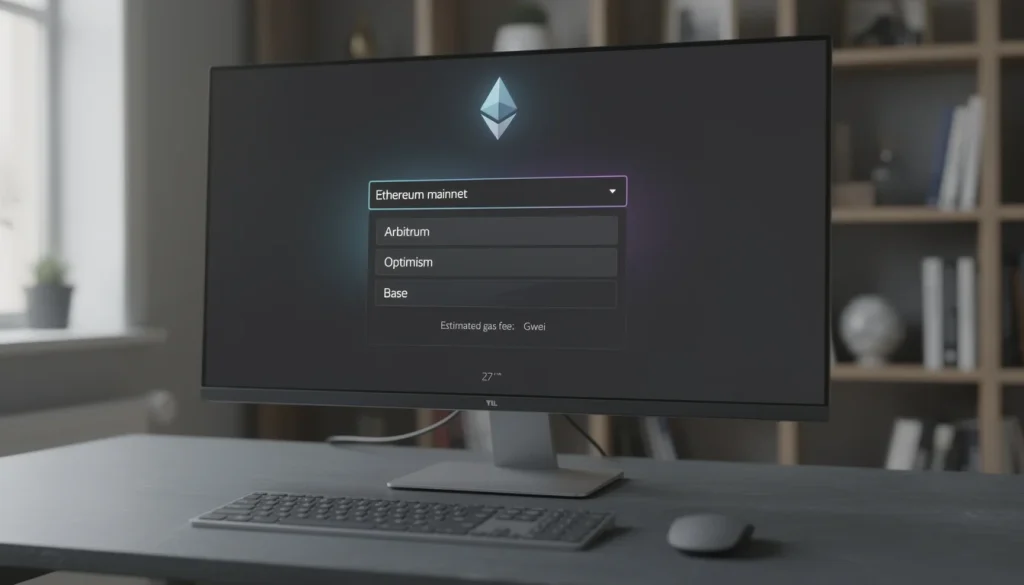
Calculating Ethereum Network Fees Before Depositing
I had a stretch in early 2024 where every Ethereum deposit I made cost more than the first bet I placed with it. £12 in gas, £20 stake on the moneyline, watching the math instinctively. That was peak frustration: a chain that was supposed to be programmable money behaving like a wire transfer with surge pricing. Then Layer 2 changed the equation. Then Layer 2 became confusing in its own way.
Ethereum’s position in the crypto betting stack is awkward. It’s the second-biggest cryptocurrency by market cap, widely supported at every major sportsbook, and structurally more expensive than the alternatives for the volume sizes a typical UK punter is running. With Bitcoin’s average confirmation time around 10 minutes and Ethereum’s between 15 seconds and 5 minutes, the speed advantage is real – but it’s gated by gas fees that can swing 50x within a single day. Stablecoins are projected to cover 70% of crypto-betting transactions in 2026, partly because they let users route around the worst of Ethereum’s fee chart.
This guide covers how gas fees actually work, why NBA betting hours collide with Ethereum’s peak congestion, how Layer 2 networks change the cost picture, the deposit-cost math you should run before sending, and what sportsbooks support which networks in 2026.
Gas fees in plain language
Every Ethereum transaction pays a fee to the network in ETH. The fee is split into two parts: a base fee that gets burned (removed from circulation) and a priority fee that goes to the validator who includes your transaction in a block. The total fee depends on how complex the transaction is (a simple ETH transfer is cheaper than a stablecoin send) and how busy the network is at that moment.
Network busyness is measured in gas price, denominated in gwei (one billion gwei equals one ETH). When the network is quiet, gas might be 5-10 gwei. When the network is congested – major NFT mint, large token launch, market panic – gas can spike to 200-500 gwei. The same simple stablecoin transfer can cost $2 in a quiet hour and $40 during congestion. The base fee adjusts automatically based on the previous block’s fullness; the priority fee is what you bid to get in faster.
For an ERC-20 USDT or USDC deposit at a sportsbook, you’re looking at a typical 65,000 gas units of computation. At 20 gwei (a moderate network state) and ETH at $3,500, that’s a fee of around $4.55. At 100 gwei during congestion, the same transaction costs $22.75. The deposit amount doesn’t change the gas cost meaningfully – it costs roughly the same to send $50 of USDC as to send $5,000.
This is why Ethereum deposits make economic sense at larger sizes and almost no sense at small ones. A £20 deposit paying £4 in gas is 20% lost before the bet. A £400 deposit paying £4 in gas is 1%, which is tolerable. The deposit threshold where Ethereum gas stops being painful is roughly the £200-300 mark for most punters.
Why NBA betting hours collide with Ethereum’s busy period
European tip-off times for NBA games run from about 19:00 GMT (early West Coast games) through 04:00 GMT (late East Coast games), with the heaviest concentration of fixtures between 01:00 and 03:00 GMT. That window overlaps with the US business day, which is when Ethereum gas consistently runs hottest because the bulk of DeFi and trading activity is US-driven.
What this means in practice is that placing an Ethereum deposit thirty minutes before a 01:00 UK time NBA tip-off is the worst possible deposit timing for cost. Gas is at or near daily highs. By the time the game’s over and you want to redeposit, the New York close has come and gas has started to ease, but the next tip-off is still hours away.
The contrarian play is to fund the betting bankroll during low-gas windows – usually 09:00-15:00 UK time on weekdays, when US markets are quiet and Asia is winding down. A £500 stablecoin top-up during a quiet window might cost $3 in gas; the same top-up at peak NBA hour costs $20. Across a 30-day cycle of weekly top-ups, that’s a saving of $60-100 just from timing.
For live betting, this is essentially a non-starter on Ethereum mainnet. You can’t time low-gas windows for live action because the game is happening when the game is happening. Live betting on Ethereum mainnet means accepting peak gas as the cost of doing business. The fix is to pre-fund larger amounts during low-gas windows and live-bet from the pre-funded balance, rather than trying to deposit mid-game.
Layer 2 networks and what they actually save
Layer 2 networks are blockchains that settle their security to Ethereum mainnet but process transactions on a separate chain at a fraction of the cost. The main options for sportsbook deposits in 2026 are Arbitrum, Optimism, Base and Polygon. Transaction fees on these networks typically run $0.05-0.50, compared to $4-20 on Ethereum mainnet. Confirmation times are usually 1-5 seconds versus Ethereum’s 15-60 seconds.
The trade-off is sportsbook coverage. Major crypto sportsbooks support some Layer 2s but rarely all of them. Arbitrum and Optimism are the most widely accepted; Polygon is supported at maybe half of major books; Base is increasingly common at newer operators. The book’s deposit page lists which networks they accept; sending USDC on a Layer 2 the book doesn’t support means the funds are gone until you can complete a cross-network bridge back to a supported network – which itself costs gas.
The right approach is to check the sportsbook’s accepted networks first, then pick the wallet that supports those networks. A Layer 2-capable mobile wallet – Trust Wallet, Rabby, or MetaMask with networks added – gives you the flexibility to deposit cheaply on whichever network your book accepts. Hardware wallets running modern firmware also handle Layer 2s without difficulty.
One operational note: bridging from Ethereum mainnet to a Layer 2 takes 5-15 minutes and costs gas for the bridge transaction. If your funds are already on mainnet, moving them to Layer 2 costs more than just paying the higher mainnet deposit fee on a single transaction. Layer 2 only saves money when you’ve been operating on Layer 2 already.
Running the deposit-cost math before you send
The math you should run before any Ethereum deposit looks like this. Take the deposit amount in GBP. Calculate the gas fee at the current network rate in GBP. Divide the gas fee by the deposit amount. If the result is over 1%, reconsider the timing or the network. If it’s under 0.5%, you’re operating efficiently.
Example: £400 deposit, gas estimated at $8 ($6.30 in GBP). That’s 1.6% of the deposit consumed by gas alone. For a punter expecting 3-5% edge from their betting, paying 1.6% per deposit is shaving a third of the edge away just on the funding side. If the same deposit could be made on a Layer 2 for $0.30 (£0.24), the gas drops to 0.06% – essentially free.
The structural problem with Ethereum mainnet for NBA betting is that the gas cost doesn’t scale with deposit size, but it scales painfully with deposit frequency. A weekly £400 deposit pays $8 in gas; that’s $416 over a year on $20,800 of total deposits – 2% leakage. Drop the deposit cadence to monthly with larger size, and the leakage drops to 0.5%. Drop to Layer 2 and it drops to under 0.1%.
The optimal strategy for most UK NBA bettors is to keep working bankroll on Layer 2 in USDC, pre-fund larger amounts during low-gas windows, and avoid Ethereum mainnet entirely for anything under £200 per transaction. The Bitcoin volatility considerations that affect stablecoin choice are explored in the provably fair basketball betting guide.
What crypto sportsbooks accept on Ethereum and Layer 2
Major crypto sportsbook coverage as of 2026: ETH on mainnet is essentially universal. ERC-20 USDT and USDC on mainnet are universal. Arbitrum support is widespread; Optimism support is at most major books; Base is at newer operators and growing fast. Polygon support has been slowly contracting at some books due to network usage patterns shifting towards Arbitrum and Optimism.
The deposit interface at most books shows the network selector prominently – you pick the network, the book generates a network-specific address, you send to that address. Sending on the wrong network is the single most expensive deposit mistake in the entire ecosystem. ERC-20 sent to a TRC-20 address, or Polygon sent to an Arbitrum address, requires manual recovery by the book if it’s even possible. Read the network selector before confirming the send.
Withdrawal-network parity is the other thing to check. Some books accept ETH deposits on multiple networks but only offer withdrawals on Ethereum mainnet. If you deposit cheaply on a Layer 2 and then withdraw on mainnet, you’ve paid the high gas on the withdrawal leg anyway. The cheapest end-to-end cycle is when both deposit and withdrawal share the same low-cost network.
Confirmation requirements vary by book and by network. Ethereum mainnet typically credits after 12-30 confirmations (3-7 minutes); Arbitrum and Optimism after fewer because the bridging security model is different; Polygon after a similar number to Ethereum mainnet. The deposit page usually displays the requirement; if it doesn’t, expect 3-10 minutes for credit on most major networks.
When are Ethereum gas fees lowest from a UK punter"s perspective?
The quietest gas windows for UK users are typically weekday mornings between 09:00 and 14:00 GMT, when US markets are closed and Asian activity is winding down. Saturday and Sunday mornings UK time also tend to run quieter than weekday evenings. Late-night UK hours (01:00-04:00 GMT), which coincide with NBA tip-offs, are the worst gas timing of the day because they overlap peak US trading activity.
Do crypto sportsbooks accept deposits from Arbitrum or Optimism?
Most major crypto sportsbooks accept Arbitrum and Optimism deposits for both ETH and stablecoins as of 2026, with the network selector visible on the deposit page. Acceptance has expanded steadily since 2023. Always confirm on the deposit page rather than assuming; sending on a network the book doesn"t support means the funds aren"t credited automatically and recovery is operationally complex.
Articles
Published by the Bitcoin Basketball Bets team.
