
NBA Quarter and Half Betting with Bitcoin: Period-Specific Markets
 Available in US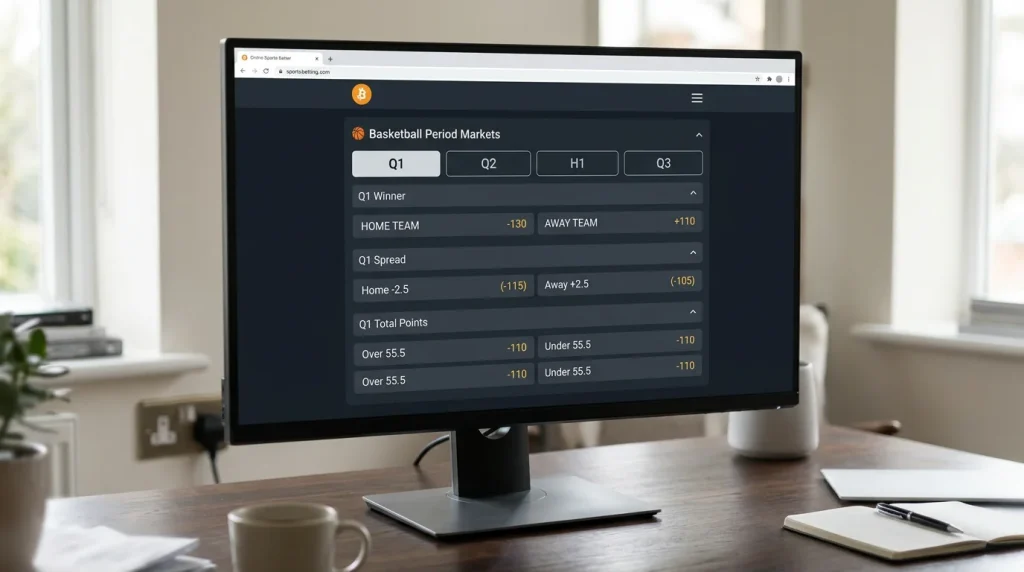
The first-quarter discipline that changed my NBA betting season
For most of my first few years betting NBA, I was a full-game bettor – spreads, totals, moneylines on the 48-minute outcome and nothing else. Then in the 2022-23 season, a colleague who’d been covering the league for a decade pointed out that I was betting the noisiest part of an NBA game and ignoring the cleanest. The first quarter, he said, is the most model-friendly period in basketball: starters are on the floor, rotations are predictable, fatigue isn’t a factor, and the sample is small enough that variance can work in your favour. He was right. Period-specific markets are now a meaningful part of my weekly NBA portfolio.
UK crypto sportsbooks list quarter and half markets on every NBA fixture and on most marquee EuroLeague games. The market depth is thinner than the full-game lines but the structural opportunities are different – and for a disciplined bettor working with a clear model, the quarter markets often offer cleaner expressions of an edge than the full-game alternatives. This guide covers why period markets exist, where the first-quarter and halftime edges live, how live period betting works, and which crypto operators have the best period menus in 2026.
Why period markets exist and where they fit in the menu
Period markets break a 48-minute NBA game into smaller settlement windows: each of the four 12-minute quarters, the 24-minute first half, the 24-minute second half, and various combinations. Each window has its own spread, total, and moneyline. The first quarter has a spread that’s typically a quarter of the full-game spread (a -6 full-game favourite is usually -1.5 in the first quarter), a total that’s roughly a quarter of the full-game number (a 230 full-game total is around 57.5 first-quarter), and a moneyline that priors in the favoured starting unit.
The reason these markets exist is that bettors with specific informational edges want to express them in the cleanest way possible. A bettor who thinks the home team’s starting line-up is materially stronger but the bench is comparable doesn’t need to bet 48 minutes of the bench differential – they can bet the first quarter and capture the starter edge in isolation. A bettor who thinks the home team is a slow starter doesn’t have to fade them on the full game; they can fade the first quarter and bet them as the game progresses if the model says so.
Approximately 7% of UK NBA viewers reported regularly betting on NBA games in the most recent UK sports betting consumer surveys, and within that group the period markets are increasingly used by bettors with model-driven approaches. Cloudbet’s Q1 2026 market report showed basketball wagering doubled year-on-year on the platform, and the period markets were among the fastest-growing segments within that growth – disproportionate to their share of overall basketball handle, suggesting the user base for these markets is shifting towards more sophisticated, data-driven bettors.
First-quarter trends and the under bias
The first-quarter total in NBA betting has a persistent structural bias towards the under that’s been documented across multiple seasons. The mechanism: starting line-ups on both teams play the first 6-8 minutes of the quarter without substitutions, the pace is typically slower than the full-game average, and the offensive efficiency hasn’t yet hit its peak (teams warm up over the first 4-6 possessions). The result is that first-quarter scoring runs slightly below the rate implied by a simple division of the full-game total.
The market has adjusted for this bias over the years, but not fully. The closing first-quarter total often sits 1-2 points below the “naive quarter of the full game” calculation, which is closer to fair value but typically not all the way there. The first-quarter under at most operators has been a small positive-expected-value position for several seasons running, particularly in games with high full-game totals (240+) where the warmup-phase effect is most pronounced.
The other first-quarter pattern that matters: home court advantage is concentrated more heavily in the first quarter than it’s spread across the four periods. The home team’s pre-game routine, crowd energy, and familiarity with the arena produce a measurable first-quarter performance lift that fades over the course of the game. A bettor who likes the home team in a particular fixture can sometimes get better value betting the first-quarter spread than the full-game spread.
The opposite pattern applies to back-to-back games on the road. A team playing the second game of a back-to-back away from home tends to start sluggishly – the travel and recovery deficit hits hardest in the first 12 minutes – and the first-quarter spread for that team is often worse than the full-game spread implies. This is one of the cleaner spots for fading a tired road team in a period market.
Halftime adjustments and the second-half market
The halftime market opens at the start of the third quarter and prices the remaining 24 minutes of the game in isolation. The line typically reflects the current scoreboard plus the operators’ updated game model – a team leading by 8 at half might be priced -4 for the second half if the model expects them to maintain the differential, or -2 if the model expects partial mean-reversion. The halftime market is one of the most actively used in-play markets at crypto sportsbooks.
The structural edge available at halftime is the operator’s model lag. The operators rebuild their second-half line in the brief interval between the second quarter ending and the third quarter beginning, and they’re working with a smaller information set than they had at game start. Game-flow signals – foul trouble, offensive rhythm, defensive scheme adjustments, player fatigue – are visible to a careful viewer but slow to be incorporated into the line. A bettor who watches the first half carefully can sometimes spot game-state factors that the operator’s model is underweighting.
Crypto sportsbooks rebuild halftime lines at roughly the same speed as fiat books. The lag isn’t dramatic at either type of operator – both have automated pricing engines that produce a second-half number within seconds of the second quarter ending. The genuine difference is depth: fiat books with high US handle (DraftKings, FanDuel) often have tighter second-half spreads than crypto books because the volume forces tight pricing. For lower-stakes UK bettors, the slightly wider crypto spread is rarely a material disadvantage and the BTC payout speed compensates on winning halves.
Live period betting and the in-play menu
Live period markets are where the crypto sportsbook advantage shows most clearly. The full live menu on an NBA game at a tier-one crypto book includes the current quarter spread, the current quarter total, the remaining-time spread and total for each subsequent period, the half-game spread, alternative spread ladders, and a range of player and team props that update as the game evolves.
The depth of this menu at Cloudbet, Stake, and BC.Game is meaningfully greater than at most UK-licensed fiat sportsbooks, which tend to focus their live menus on the full-game spread, total, and moneyline plus a small number of period markets. The crypto books are willing to maintain wider, more granular menus because their automated pricing engines can support the additional markets without manual trading overhead.
The bettor strategy for live period markets is to identify game-state factors that haven’t been priced in. A team going on a 12-2 run in the second quarter often sees their first-half over total mispriced for a brief window as the model catches up. A starter going to the bench with foul trouble mid-quarter creates a window where the remaining-quarter spread is mispriced before the lineup adjustment is reflected. These are small-edge opportunities that compound over a season of attentive in-play betting.
Crypto sportsbook coverage of period markets in 2026
The period market coverage at the major crypto sportsbooks varies in depth more than the full-game coverage does. Cloudbet has the deepest period menu, with quarter and half markets on every NBA fixture, alternative period spreads, and period-specific player props on marquee games. Stake covers the standard period markets plus some unique structured props (highest-scoring quarter, team to lead at each break) that aren’t widely available elsewhere.
BC.Game’s period menu is solid on the main markets but thinner on the alternative ladders. Sportsbet.io covers the basics. For UK bettors prioritising period market depth, Cloudbet is the operator with the most consistent coverage across the NBA regular season and play-offs.
The integration of period bets into multi-leg parlay structures is another consideration. Period-leg parlays at crypto sportsbooks – first-quarter spread on one game combined with first-half total on another, or full-game moneyline on one combined with second-half total on the same fixture – are where the cumulative-edge mathematics of basketball parlays interact with period-specific value. The full framework for parlay construction at crypto sportsbooks sits in the NBA parlay bitcoin guide, and reading both gives you the toolkit to combine period and full-game positions intelligently.
Building period markets into a UK bettor’s weekly routine
The UK punter who adds NBA period markets to their weekly betting routine in 2026 should start with a narrow focus. Pick two specific period market types – first-quarter total under in high-total games, halftime adjustments in foul-trouble situations, whatever fits your model – and bet them consistently for a month before adding more market types. The variance on period markets is higher than on full-game markets (smaller sample, more noise), so a longer evaluation window is needed to assess edge.
The crypto sportsbook environment supports this approach better than the fiat alternative because the menu is deeper, the live updates are faster on the better operators, and the BTC settlement speed means period winnings are available for re-staking within minutes of game completion. A UK bettor who treats NBA period markets as a serious portion of their weekly portfolio will find structural opportunities that full-game-only bettors don’t access. The learning curve is short; the menu is deep; the seasonal upside is real.
Why do first-quarter NBA totals tend to favour the under?
The first quarter has structural pace and efficiency characteristics that produce slightly lower scoring than a naive quarter of the full-game total would suggest. Starting line-ups play the first 6-8 minutes without substitution, pace is typically slower than the full-game average, and offensive efficiency takes the first few possessions to reach its rhythm. The market has adjusted for this bias over time but often not fully – closing first-quarter totals usually sit 1-2 points below the simple quarter-of-the-full-game calculation, leaving a small positive-expected-value opportunity for under bettors particularly in high-total games (240+) where the warmup effect is most pronounced. This isn"t a guaranteed edge but a persistent bias documented across multiple seasons.
Are halftime adjustments at crypto books slower than at fiat books?
The speed difference is minimal at the tier-one operators on both sides. Both crypto books (Cloudbet, Stake, BC.Game) and major fiat books (DraftKings, FanDuel) use automated pricing engines that produce a second-half number within seconds of the second quarter ending. The genuine difference is depth and tightness: high-volume fiat books often have slightly tighter second-half spreads because the heavy handle forces competitive pricing, while crypto books may run slightly wider margins. For UK bettors with moderate stakes, the wider crypto spread is rarely material and the BTC settlement speed advantage compensates on winning halves. The lag itself is comparable.
Articles
Prepared by the Bitcoin Basketball Bets editorial staff.
