
NBA Bitcoin Parlays and Crypto Accumulators in the UK
 Available in US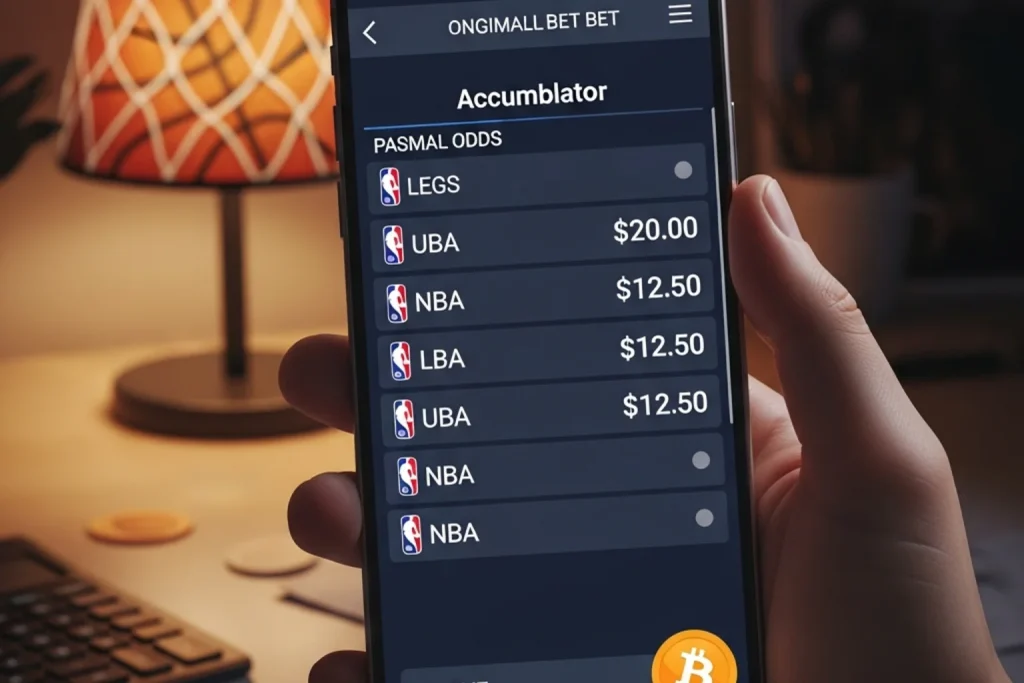
Risk Management for NBA Accumulator Structures
Ask me about the biggest single ticket I’ve ever cashed and the answer is a parlay. Five-leg NBA combo, two underdogs and three favourites, hit clean across a Saturday night. Ask me about the most consistently losing structure I’ve ever tracked across 18 months of betting records, and the answer is also parlays. Both things are true at once. That’s the parlay problem in one paragraph.
NBA parlays – what UK punters call accumulators, what US punters call parlays, what the books all call high-margin product – are the market where the gap between the size of the potential win and the realistic probability of winning is at its widest. With basketball stake volumes nearly doubling at major crypto sportsbooks in 2026, parlays have become the highest-margin product on the menu, contributing meaningfully to the kind of GGR figures that put leading operators in the $4.7 billion annual revenue range. The reason isn’t a mystery: the math compounds against the punter.
This guide unpacks how a parlay’s math actually works, what same-game parlays change about that math, how the payout settles when your stake and winnings are both in Bitcoin, and where the structural EV problem sits – because understanding it doesn’t mean never playing them, but it does mean playing them with eyes open.
What a parlay is, in UK and US terms
A parlay is a single bet that combines two or more individual selections; every selection has to win for the parlay to win. One miss and the whole ticket loses. Lakers ML, Celtics -6, total over 232.5 – three legs, one bet. In UK betting language this is a treble, and a four-leg version is a four-fold accumulator. The mechanics are identical; only the vocabulary changes.
The price on a parlay is the multiplicative product of the individual prices, converted to decimal odds. Three legs at -110 each becomes 1.9091 × 1.9091 × 1.9091 = 6.957 decimal, which is +595.7 in American terms. Multiply by your stake and that’s your potential return. The book isn’t doing you a favour by combining the legs – they’re doing themselves a favour, because the parlay’s combined house margin is the compounded version of each leg’s individual margin.
The crypto sportsbook parlay menu generally extends from 2-leg up to 12 or 15 legs at most books, with some allowing up to 20. The longer the parlay, the more the book is incentivised to offer it and the more the punter is incentivised to walk away. The 15-leg ticket priced at +50,000 sounds attractive; the implied probability is something like 0.2%, and the fair price would be closer to +90,000 once you account for the compounded vig.
One ground rule that applies everywhere: a parlay is one bet, not many. If three of four legs win and the fourth loses, you don’t get paid 75% of the potential. You get nothing. That binary structure is what creates the parlay’s psychological pull – the chance of a single big win – and what destroys its long-term expected value.
Many successful accumulators include legs focused on NBA over/under totals rather than just picking outright winners.
The math that decides parlays lose money over time
Take three independent NBA bets, each at -110 in American odds. -110 implies a 52.4% win probability if the bet were fair (it isn’t – -110 means breakeven is at 52.4% but fair value would be 50%, with the 2.4% gap being the vig). Each leg pays 1.909 decimal.
Combine those three legs into a parlay. The decimal odds multiply: 1.909 × 1.909 × 1.909 = 6.957. The implied probability of the parlay at the offered price is 14.4%. Meanwhile, the true probability of three independent 50/50 bets all winning is 12.5%. The gap – 14.4% implied versus 12.5% actual – is the house edge on the parlay, and it works out to a 13% expected-value loss per ticket. Three independent -110 legs as singles lose 2.4% over time; combined into a parlay they lose 13%. The vig compounds.
The compounding isn’t linear; it accelerates with leg count. A five-leg parlay of -110 lines runs around a 22% expected-value loss. An eight-leg version is closer to 35%. Books love long parlays for the same reason punters do – both sides want the long-shot story, but only one side gets paid for it consistently.
There’s exactly one way to make a parlay structurally positive: identify mispriced lines on at least some legs and compound the edge alongside the vig. If a -110 leg is actually a -125 fair line, you have a 3-4% edge on that single bet. Stack two or three such legs and the compounded edge can outpace the compounded vig. That’s not a parlay strategy – it’s the underlying edge dressed up. The parlay is a vehicle, not a source of value.
Same-game parlays and the correlation trap
The same-game parlay is the market that’s exploded across crypto books in the last two years. Instead of combining picks across different games, you combine picks from one game – LeBron over 25.5 points, Lakers -6, total over 228.5, Anthony Davis over 10.5 rebounds. The book recalculates the price to account for correlation between the legs, because they’re no longer independent events.
Correlation is the whole game on same-game parlays. If the total goes over, the Lakers winning by a comfortable margin is more likely. If LeBron scores 30, the total is more likely to clear. Those correlations are positive – events that move together. The book prices them in by reducing the parlay payout below what the naive multiplication would suggest. A three-leg same-game ticket that would pay +500 if the legs were independent might pay +320 because the book has already adjusted for the correlation.
The trap is that the book’s correlation adjustment is conservative – they round up the correlation discount in their favour. The fair correlation might justify +400; they offer +320. Same-game parlays carry the highest house margins of any NBA product, often in the 18-25% range. They’re also marketed the hardest, given the headline payouts and the storytelling angle of stacking one team’s “perfect night”.
The exception worth knowing: contrarian-correlation legs sometimes price cleanly. Pairing an under with a particular player going over their points line, or pairing a team moneyline with their opponent’s rebound leader going over – these legs have negative or near-zero correlation, and the book typically prices them as if they were independent. You’re effectively getting the standard multiplicative payout on legs that move together less than the book’s model assumed. Spot these and you’ve found the only place in the same-game parlay market that doesn’t actively penalise you.
How a Bitcoin parlay actually settles
The settlement mechanics on a crypto parlay are identical to a single bet. Stake 0.005 BTC, ticket priced at +400 (5.0 decimal), potential return 0.025 BTC. The book locks the price at placement; if any line moves before tip-off, your locked-in price is what pays.
Where Bitcoin adds friction is settlement timing on multi-day parlays. A three-leg ticket with games on three consecutive nights stays open for 72 hours. In that window, BTC can move 5-10% without anything unusual happening. The 0.025 BTC potential return at placement might be worth £1,000 then and £950 at settlement. You can’t hedge the BTC exposure on an open parlay without effectively voiding the bet, so you’re carrying coin risk on top of cover risk for as long as the ticket is live.
The default crypto-book practice is to settle each leg as it completes, marking it as won/lost/pushed without paying out until the whole ticket resolves. If a leg pushes – for example, an integer-line spread that lands exactly on the number – most books drop that leg from the parlay and recalculate the payout with the remaining legs. A few books treat a push as a loss for the whole ticket. The terms are in the bet slip; read them before staking on integer lines.
Cash-out exists on some parlays mid-ticket, usually at terrible value. The book offers maybe 60% of the true mid-ticket equity. If you find yourself wanting to cash out a parlay after one leg cleared, the smarter move is usually to hold the ticket and place an offsetting single on the next leg’s losing side at a different book – a structural hedge rather than accepting the cash-out haircut.
Build your multi-leg wagers with confidence using the insights from Bitcoin Basketball Bets.
The honest case for and against parlays in your routine
The case against parlays is the math: compounded vig, correlated traps, and a structural EV deficit that scales with leg count. The case for parlays is narrower but real: they offer asymmetric variance for a small fraction of a bankroll, and they can convert genuine edges on multiple games into a single ticket with magnified upside.
The discipline pattern that works is to cap parlay volume at maybe 5-10% of weekly NBA stakes and to keep legs to 2-3 maximum. Two-leg parlays carry roughly twice the single-bet vig, not the catastrophic compounding of five or six legs. They produce useful payouts on confluent reads – say, a moneyline and a total both moving the same direction – without the magnification of vig that longer tickets create.
Treat parlays as variance instruments, not value plays. If you go in expecting positive long-term return, the math will disabuse you of that expectation within a hundred tickets. If you go in knowing you’re paying a premium for the chance at a big single hit, and you size accordingly, parlays have a small useful place. The real volume should stay on singles where the vig is half what it is on multi-leg tickets, and where the next natural step – taking those single-game edges into live in-play – is laid out in the live NBA crypto guide.
How is an accumulator different from a same-game parlay?
An accumulator combines picks from different games – Lakers vs Boston, Bucks vs Heat, Warriors vs Nuggets – into one ticket. A same-game parlay combines multiple picks from a single game. The math is similar but same-game parlays have the legs priced with correlation adjustments because the events influence each other, and house margins on same-game tickets typically run 18-25% versus 8-15% on standard multi-game accumulators.
Do crypto sportsbooks pay a higher parlay boost than UK fiat books?
Some crypto sportsbooks offer parlay boost promotions – 10-25% added to the standard multiplier on 4-leg or longer tickets. The boost looks generous on the bet slip but rarely closes the structural EV gap; a 20% boost on a parlay carrying a 25% house margin still leaves the punter at -5% expected value. The boost has real value as a marketing offer rather than as a long-term edge.
Articles
Created by the "Bitcoin Basketball Bets" editorial team.
