
NBA Over/Under Bitcoin Betting and Totals Markets
 Available in US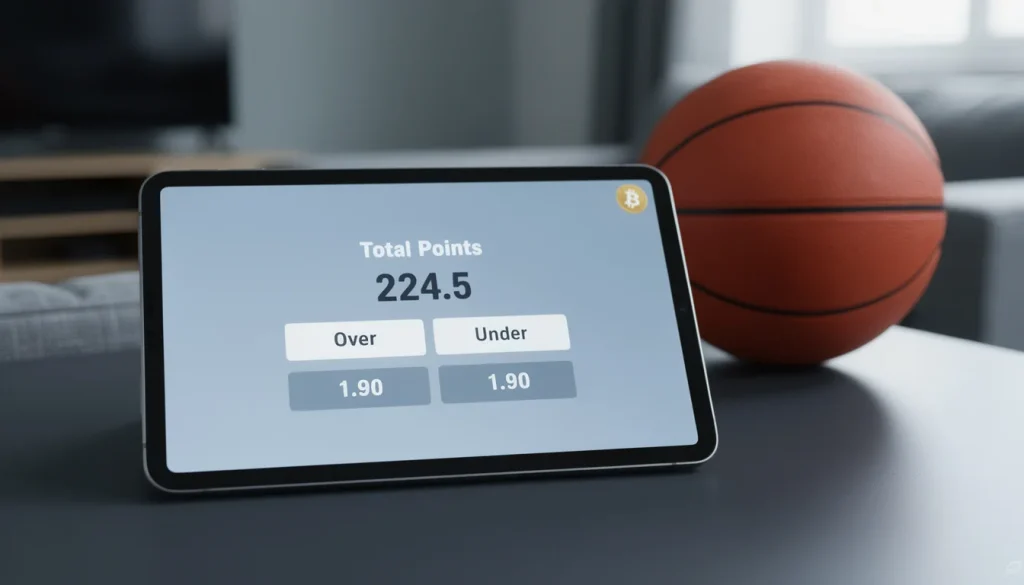
Wagering on NBA Game Tempo and Scoring Environments
I started taking totals seriously the night I watched a game I had zero opinion on – Detroit at Sacramento, middle of February, no playoff implications – and the line opened at 245.5. I knew nothing about who was going to win and didn’t care. I knew exactly what both coaches wanted on that floor, which was full-court pace and minimal half-court sets. The over hit by twenty.
That’s the totals market in one sitting: a bet on pace and scoring environment, not on who wins. You’re not picking a side; you’re predicting whether the combined points cross a line set by the book. For UK punters arriving from football, where over/under markets feel limited and slow-moving, NBA totals are the opposite – they live and breathe through every possession, the live market shifts every fifteen seconds, and the structure of the game makes them tradable in a way football totals rarely are.
Live in-play action now holds the largest share of global sports-betting revenue, and totals are the single most-traded NBA market within it. This walkthrough covers the basics, the pace factor that drives the line, the live mechanics that make halftime such a critical inflection point, and the practical conversion math when your stake is in Bitcoin instead of pounds.
Totals in their simplest reading
The totals line is a single number: the bookmaker’s projection for combined points scored by both teams. Lakers vs Boston with a total of 224.5 means the over bets on 225+, the under bets on 224 or fewer. Half-points exist for the same reason they exist on spreads – to eliminate the possibility of a stake-returning push.
The price next to the line is what tells you whether the book is leaning. A flat over/under at 224.5 priced -110 either way is a market-neutral line – the book wants equal action. A line at 224.5 with the over priced -120 and the under +100 is a book that’s seen heavy over money and is now charging punters for the privilege of pushing further in that direction. The line doesn’t always move; the price often moves first.
Half-time totals exist alongside full-game totals, and they trade differently. A half-time line will sit roughly around 50-52% of the full-game line – not exactly half, because NBA scoring tends to be marginally higher in the second half than the first. First-quarter totals exist at most crypto books with smaller limits – they’re a useful read on pace early but you’re working with a noisy 12-minute sample. The same broader logic that applies to game-level alternative markets is unpacked in the NBA game props guide, including how first-quarter and overtime markets sit alongside totals.
Settlement on full-game totals includes overtime by default at virtually every crypto sportsbook – that’s the industry standard. Read the bet slip to confirm, because the exceptions are rare but real. An overtime period adds a possessions-heavy stretch that’s almost always over-friendly relative to regulation pace, which is why heavy under bets sweat hard when a game hits OT with the total still in play.
Pace is the variable that prices the line
The total is essentially a pace-and-efficiency math problem dressed up as a single number. Pace is possessions per 48 minutes; offensive rating is points per 100 possessions. Multiply two team pace estimates by their adjusted offensive ratings against the opponent’s defence and you’ve reconstructed the bookmaker’s working number.
NBA pace varies more than people realise. The top teams in 2025-26 run at over 102 possessions per 48; the slowest sit around 94. An eight-possession swing per game between two fast teams against two slow teams shifts the natural total by 16-18 points. That’s why a Lakers vs Boston number can sit at 218 while Indiana vs Atlanta sits at 238 the same night. The teams aren’t ranked differently on offence by the gap between those totals – they play at different speeds.
The variables that move pace mid-season are well-known and worth tracking. Rest days favour higher pace because tired legs play half-court; back-to-back games for one or both teams pull the total down. Coaching change, even mid-season, can shift pace by three-plus possessions. Injuries to a primary ball-handler usually slow a team down because nobody else triggers transition the same way. The full audience for NBA basketball in the UK is small – 7% of internet users, the lowest share among the six major markets tracked by industry research – but that audience is young, online and tactically literate. The total is the market where that knowledge converts into edge most directly.
Scoring environment also matters across the broader season. Refereeing trends, three-point volume, and free-throw rates shift league-wide totals by a couple of points across a campaign. The early-season total of 230 might be a mid-season 226 if the league tightens up officiating around the All-Star break. Tracking those drifts is part of why totals reward time spent – a casual punter can read the line tonight, a serious one knows where the line should be tonight relative to where it sat in November.
The mechanics that make live totals tradable
Pre-game totals are a single number that locks at tip-off. Live totals are a moving target that shifts after every made basket, every defensive stop, every timeout. The book recalculates the live number using the score so far, the time remaining, and a pace model that’s tracking the actual game flow against the expected.
The fastest live market move I’ve watched was a game opening at 226.5 that hit halftime at 102 combined points – six points ahead of the projection at the break – and the live full-game line jumped to 236.5 within two minutes of the third-quarter tip-off. Anyone holding pre-game unders at 226.5 had a decision: cash out at a partial loss, or hold and hope for a defensive second half. Most cashed out. The game ended at 233. The under would have lost; the cash-out was the right call given the information at the moment.
The structural feature of live totals is that they overreact to the most recent quarter. A high-scoring first quarter prices the second quarter as if it’ll repeat – and second quarters in the NBA almost always slow down because bench rotations come in. That’s the spot where live unders tend to print value, especially on games where the first quarter ran 65+ combined points. Pre-loading a live-unders watchlist before tip-off – flagging the games you think will have a hot first quarter that you’ll then fade – is how live totals turn from a chaos market into a tradable one.
Latency matters here. Most crypto books run on data feeds with a two-to-five second lag against live TV in the UK; the book lags slightly more than the feed because of the suspension-and-reopen cycle during plays. If you’re trying to bet a totals movement based on what just happened on screen, you’re usually too late. The play is to position before the obvious move comes, not chase it after.
The Bitcoin layer when your stake is in coin
The totals market itself doesn’t care what currency you fund in. Your 0.005 BTC at 224.5 over -110 settles the same way as £200 at the same line. The Bitcoin layer matters in two places: how the stake is sized day to day, and how the winnings are valued at settlement.
Sizing in coin and treating the resulting GBP value as stable is the trap. A 0.005 BTC unit in November might be £180; the same 0.005 BTC in February might be £260 because the asset moved 45% in three months. NBA seasons run long enough that this drift is real money. Anchoring to a GBP-denominated unit and recalculating the coin amount weekly removes the drift from the equation.
The settlement layer adds a tiny twist on live totals specifically. If you take an under at half-time and the bet settles forty minutes later when the final buzzer goes, BTC could have moved 1-2% in that window. On a winning under, that means your winning coin amount is worth slightly more or less in GBP than the screen suggested when you placed the bet. The drift is small per ticket and unavoidable; the point is to count it across a season rather than be surprised by it.
What experienced totals bettors actually do differently
The amateurs watch the score and bet the over when teams are scoring. The pros watch the pace and bet the over when teams are running, regardless of score. There is a difference, and it shows up across a season.
The discipline pattern is the same in every market that pays off slowly. Pick five games a night, not fifteen. Build a totals projection in advance – even a rough one – and only act when the line is more than a couple of points away from your number. Live betting only on games where you’ve already done the pre-game work; chasing live totals on games you didn’t watch the first half of is gambling, not betting.
One more habit that separates the patient from the impatient. Don’t bet a total because the players you like are scoring. Bet a total because the pace and scoring environment justifies it. Stars get hot and cold; pace is structural. The pace number lives in possessions per 48 and it doesn’t care which player is in form this week. That’s the read totals reward, and it’s the reason this market keeps being the deepest one on the NBA board year after year.
How does NBA pace influence a totals line?
Pace is possessions per 48 minutes; the more possessions, the more chances to score. A game between two top-pace teams will price 15-20 points higher than a game between two slow teams of equivalent offensive efficiency. The book builds the total from each team"s pace, offensive rating and the opponent"s defensive rating against the league average. Reading pace is the single most useful skill in the totals market.
Are first-half totals better value than full-game totals at crypto books?
First-half totals can offer cleaner value because they remove garbage-time noise and bench-rotation chaos from the equation. The trade-off is shallower markets – limits are usually 30-50% of full-game limits at crypto books, and the prices are sometimes a touch wider on margin. The value comes from the fact that first-half pace projections are easier to model accurately than full-game ones, where late-game situations distort the totals.
Articles
Prepared by the Bitcoin Basketball Bets editorial staff.
