
NBA Player Props with Bitcoin: Points, Rebounds and Assists Markets
 Available in US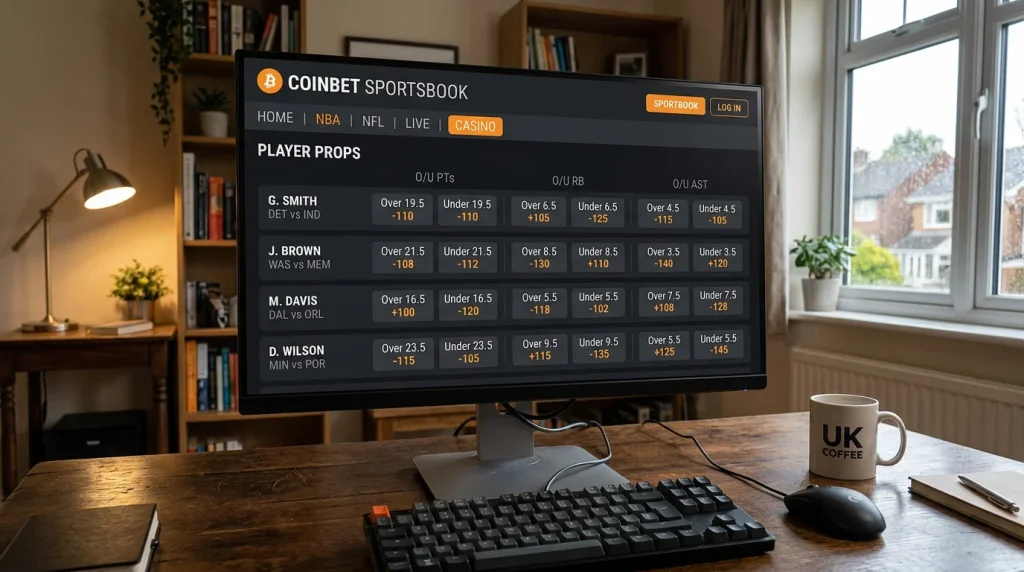
The Luka prop that taught me about line shopping
February 2024, Mavericks at Knicks at the Garden. I’d been working a model on Luka Dončić’s scoring against weak point-of-attack defenders and had him projected for 38 against a New York guard rotation that couldn’t contain him. The over on his points line at Cloudbet was 33.5; at BC.Game it was 32.5; at a UK fiat book a friend was using, 34.5. I took the 32.5 at BC.Game, Luka dropped 39 with 7 assists, and the difference between the BC.Game line and the fiat line worked out to roughly 12% more EV on the same call. That night I started building line-shopping into every prop bet I placed, and player props have been a meaningful share of my NBA portfolio ever since.
Player props are different from game props (which cover game-level events like first scorer, first quarter winner, and total quarter outcomes). Player props price individual statistical outcomes – points, rebounds, assists, threes made, steals, blocks, double-doubles, triple-doubles – for each starter and most key rotation players. This guide covers the points, rebounds and assists markets specifically, the line-shopping mechanics across crypto operators, the impact of injury news on prop prices, and the UK regulatory considerations as the FCA’s October 2027 framework approaches.
Player props explained: what’s in the menu
The standard player props menu at a tier-one crypto sportsbook covers four main statistical lines per starting player. Points (over/under a line typically set to the season-to-date average adjusted for matchup), rebounds (similar mechanic), assists (similar), and three-point makes (typically a lower-volume market with wider odds). Beyond the four main lines, the menu extends to combined props (points + rebounds + assists, or “PRA”), double-double yes/no, triple-double yes/no, and a range of period-specific player props (first-quarter points, first-half rebounds).
The pricing structure on player props is generally over/under at roughly even odds (1.85-1.95 each side at tight books), with the line itself adjusted to balance the action. The operator’s edge is in the implied margin (the gap between the over and under odds compared to a true 2.00/2.00 fair line), which on player props at the major crypto books typically runs 4-6% depending on the operator and the player’s profile.
Cloudbet’s Q1 2026 market report flagged that basketball wagering doubled year-on-year on the platform, and player props were a significant contributor to that growth. The combination of NBA viewership in the UK (concentrated among under-35 viewers who skew towards more granular betting) and the deep prop menus at the crypto operators has produced a sustained shift towards player-prop betting and away from full-game spread/total/moneyline as the dominant market structure.
Points markets: where the volume sits
The points market is the deepest and most actively traded player prop at every major crypto sportsbook. Margins are tightest here because volume forces it – Cloudbet and Stake both run points markets at margins approaching 4% on marquee players, which is competitive with the fiat alternatives serving the UK market. For high-volume players (Luka, Embiid, Tatum, Giannis) the points lines are set within 0.5 points of each other across the major operators on most game nights.
The structural variance in points markets is real. An NBA starter’s points distribution game-to-game is wider than the mean-revertive analysis often implied – high single-game variance is the rule. A model that captures matchup-specific factors (defensive rating of the assigned defender, pace differential, foul-trouble probability, garbage-time exposure) can identify games where the operator’s line is structurally too low or too high. The over/under decision is then a question of whether your model edge survives the operator’s margin.
The line-shopping edge on points is concentrated in the second-tier players. Top-tier players have tight lines across operators because every book has a model on them and the action balances quickly. Mid-rotation players who score 8-14 points per game have wider line dispersion because the operator models are less precise and the volume is lower. A bettor who follows the rotation patterns of a small set of teams can find regular line-shopping opportunities on these mid-tier prop bets.
Stake.com generated $4.7 billion in GGR in 2024 and is the largest crypto sportsbook by volume globally, and their points market depth reflects that scale – more obscure rotation players have published prop lines at Stake than at any of the other major operators. For UK bettors focused on second-tier player props, Stake’s menu coverage is the most complete.
Rebounds and assists: the lower-volume markets
The rebounds market has structurally wider margins than the points market because the volume is lower and the variance per player is higher. Rebound totals are heavily matchup-dependent (pace, defensive rebound percentage of the opposing team, presence or absence of the opposing centre) and the model uncertainty is correspondingly higher. Margins at the major crypto books on rebounds run 5-7%, noticeably wider than the points market.
The structural opportunities in the rebounds market come from pace and matchup factors that the operator models underweight. A high-pace game (110+ possessions projected) materially lifts rebound opportunities for both teams’ frontcourt players. A game where the opposing centre is questionable with injury or in foul trouble creates a rebounding window for the available big. These factors aren’t always fully priced into the rebound line, and a bettor who watches rotation and matchup news can find regular value.
The assists market is the most matchup-sensitive of the three core player props. Assist totals depend on team shooting efficiency (an assist requires a made shot from the assisted player), pace, and the specific role of the player within the offence on that night. The variance is high, the margins are wider than points (typically 5-6%), and the line-shopping dispersion across operators is larger than for points. For bettors with a view on team offensive flow against a specific defensive scheme, assists props offer some of the highest-EV opportunities in the player-prop menu.
The combined PRA (points + rebounds + assists) prop is the prop most commonly used for star players where the bettor has a view on overall production but not the specific category split. PRA lines are typically priced more tightly than the sum of the three individual lines (the operator margin on PRA is lower than the cumulative margin on three separate over bets), so for high-confidence calls on a star player’s overall production, PRA can be the more efficient market choice.
Line shopping across crypto books
The line-shopping discipline that matters on player props is more demanding than on full-game spreads because the menu is wider and the line dispersion per market is larger. A bettor who wants to consistently take the best price on a given prop needs to check three or four operators before placing the bet. The mobile UX friction discussed earlier in the cluster is real but the EV gain is meaningful – 5-15 cents on the dollar across a season of prop bets is the difference between break-even and profitable.
The operators worth comparing for player props are Cloudbet (deep menu, tight margins on points), Stake (broadest menu coverage especially on second-tier players, competitive pricing), BC.Game (good coverage of combined props and double-double markets), and Sportsbet.io (lighter menu but occasionally favourable pricing on marquee player props). The line dispersion across these four operators on a typical game night is 0.5-1.5 points on points props for top-tier players, and 1-3 points on rebounds and assists for the same players.
The crypto sportsbook line-shopping advantage compounds with the EV-finding discipline that applies to all player-prop markets. The full framework for finding positive-expected-value spots in basketball betting – closing line value, model construction, edge measurement – sits in the NBA value betting bitcoin guide, and the prop-specific application of that framework is one of the highest-density EV environments available to a UK bettor.
Injury news, line moves, and the UK regulatory backdrop
Player props are the single most injury-sensitive market on the crypto sportsbook menu. A starting-lineup announcement that drops a starter from the rotation can move a teammate’s points line by 4-6 points within minutes, and the operator response speed varies considerably across the major books. The tier-one operators (Cloudbet, Stake) have automated systems that pull starting lineups from the official feeds and adjust the prop board within 30-60 seconds. The second-tier operators may take 5-10 minutes to fully reprice.
The bettor advantage in this window is short but real. A reserve player promoted to the starting lineup ahead of a struggling starter has prop lines that haven’t fully repriced for the upgrade, and the over on his points/rebounds/assists is often a high-EV position for the brief window before the line catches up. Setting starting-lineup alerts (most NBA news services post them roughly 30 minutes before tip-off) is the single highest-value habit a UK player-prop bettor can develop.
The UK regulatory backdrop matters for the medium-term picture. Industry expert Elliot, writing in EEGaming’s February 2026 legal analysis, said: “If the FCA authorisation regime is phased in over a longer period, mainstream adoption in UK gambling could be correspondingly slow. That said, existing AML registration requirements for crypto-asset service providers already provide some baseline assurance.” The implication for prop bettors is that the operators currently offering deep prop menus to UK users will likely continue to do so through 2027, but the regulatory perimeter will tighten over time. UK punters using offshore crypto sportsbooks for prop betting should expect the operating environment to continue evolving.
The prop-betting habit that compounds across an NBA season
The UK punter who takes player props seriously in 2026 develops three habits that compound across the 1,230-game NBA regular season. First: check three operators on every prop bet before placement and take the best line. Second: set starting-lineup alerts and act on injury news within the first 5 minutes of announcement. Third: keep a record of closing line value across all settled prop bets – the bettor who consistently beats the closing line on player props is finding genuine edge and can scale stakes with confidence.
The crypto sportsbook environment is where the player-prop menu is deepest, the line-shopping opportunities are widest, and the BTC settlement speed compensates for the operating-environment uncertainty around UK regulation. A disciplined UK bettor working the points, rebounds, assists and combined markets across a full NBA season has a more granular toolkit than full-game-only bettors and a measurable expected-value advantage when the discipline is applied consistently.
Which player-prop market has the tightest margin at crypto sportsbooks?
The points market for top-tier NBA players (Luka, Embiid, Tatum, Giannis, and similar) has the tightest margins at the major crypto sportsbooks – typically 4-5% at Cloudbet and Stake, comparable to the fiat alternatives serving the UK market. The volume on these markets forces competitive pricing across operators, and lines are usually within 0.5 points of each other on any given game night. Rebounds and assists markets have wider margins (5-7%) because volume is lower and per-player variance is higher. Combined props like PRA (points + rebounds + assists) sit between the two – tighter than the individual component sum but wider than the points-only market.
How quickly do crypto books move lines after a starting-line-up announcement?
The tier-one crypto operators (Cloudbet, Stake) have automated systems that pull starting lineups from the official NBA feeds and adjust the prop board within 30-60 seconds of announcement. Second-tier operators (BC.Game, Sportsbet.io and smaller books) may take 5-10 minutes to fully reprice. The brief window between announcement and full repricing at the slower operators is where alert bettors can find value – particularly on reserve players promoted to starting roles whose points and rebounds props haven"t yet adjusted for the upgrade. Setting starting-lineup notifications from a reliable NBA news service is the single highest-value habit a player-prop bettor can adopt.
Articles
Written by the editors at Bitcoin Basketball Bets.
